

Motion Along a Coordinate Line
Exercises 1–6 give the positions s = f(t) of a body moving on a coordinate line, with s in meters and t in seconds.
c. When, if ever, during the interval does the body change direction?
s = 25/(t + 5), −4 ≤ t ≤ 0
Verified step by step guidance
Motion Along a Coordinate Line
Exercises 1–6 give the positions s = f(t) of a body moving on a coordinate line, with s in meters and t in seconds.
c. When, if ever, during the interval does the body change direction?
s = 25/(t + 5), −4 ≤ t ≤ 0
Right circular cylinder The total surface area S of a right circular cylinder is related to the base radius r and height h by the equation S = 2πr² + 2πrh.
c. How is dS/dt related to dr/dt and dh/dt if neither r nor h is constant?
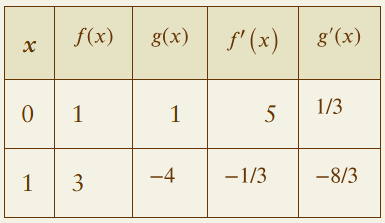
Suppose that functions ƒ(x) and g(x) and their first derivatives have the following values at x = 0 and x = 1.
x ƒ(x) g(x) ƒ'(x) g'(x)
0 1 1 -3 1/2
1 3 5 1/2 -4
Find the first derivatives of the following combinations at the given value of x.
c. ƒ(x) , x = 1
g(x) + 1
Diagonals If x, y, and z are lengths of the edges of a rectangular box, then the common length of the box’s diagonals is s = √(x² + y² + z²).
c. How are dx/dt, dy/dt, and dz/dt related if s is constant?
Differentiability and Continuity on an Interval
Each figure in Exercises 45–50 shows the graph of a function over a closed interval D. At what domain points does the function appear to be
c. neither continuous nor differentiable?
Give reasons for your answers.
Particle motion At time t, the position of a body moving along the s-axis is s = t³ − 6t² + 9t m.
c. Find the total distance traveled by the body from t = 0 to t = 2.