
Textbook Question
Computer Explorations
Use a CAS to perform the following steps in Exercises 55–62.
b. Using implicit differentiation, find a formula for the derivative dy/dx and evaluate it at the given point P.
2y² + (xy)¹/³ = x² + 2, P(1,1)

 Verified step by step guidance
 05:44
05:44
 05:02
05:02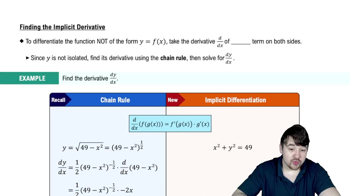 05:14
05:14Computer Explorations
Use a CAS to perform the following steps in Exercises 55–62.
b. Using implicit differentiation, find a formula for the derivative dy/dx and evaluate it at the given point P.
2y² + (xy)¹/³ = x² + 2, P(1,1)
Suppose that the functions f and g and their derivatives with respect to x have the following values at x = 0 and x = 1.
" style="max-width: 100%; white-space-collapse: preserve;" width="250">
Find the derivatives with respect to x of the following combinations at the given value of x.
c. f(x) / (g(x) + 1), x = 1
Right circular cylinder The total surface area S of a right circular cylinder is related to the base radius r and height h by the equation S = 2πr² + 2πrh.
c. How is dS/dt related to dr/dt and dh/dt if neither r nor h is constant?
Suppose that functions ƒ(x) and g(x) and their first derivatives have the following values at x = 0 and x = 1.
x ƒ(x) g(x) ƒ'(x) g'(x)
0 1 1 -3 1/2
1 3 5 1/2 -4
Find the first derivatives of the following combinations at the given value of x.
c. ƒ(x) , x = 1
g(x) + 1
Diagonals If x, y, and z are lengths of the edges of a rectangular box, then the common length of the box’s diagonals is s = √(x² + y² + z²).
b. How is ds/dt related to dy/dt and dz/dt if x is constant?
Particle motion At time t, the position of a body moving along the s-axis is s = t³ − 6t² + 9t m.
c. Find the total distance traveled by the body from t = 0 to t = 2.