
Ch. 3 - Derivatives
Hass - Thomas' Calculus 15th Edition
Hass15th EditionThomas' CalculusISBN: 9780137616077Not the one you use?Change textbook
Chapter 3, Problem 3.4.7c

Particle motion At time t, the position of a body moving along the s-axis is s = t³ − 6t² + 9t m.


c. Find the total distance traveled by the body from t = 0 to t = 2.

Verified step by step guidance
1
First, find the velocity function by differentiating the position function s(t) = t³ − 6t² + 9t with respect to time t. This gives v(t) = ds/dt = 3t² - 12t + 9.
Determine the critical points where the velocity is zero or undefined, as these points may indicate changes in direction. Solve the equation 3t² - 12t + 9 = 0 to find the critical points.
Evaluate the position function s(t) at the critical points and the endpoints t = 0 and t = 2 to determine the positions of the body at these times.
Calculate the distance traveled between each pair of consecutive points by taking the absolute value of the difference in position values. This accounts for any changes in direction.
Sum the absolute distances calculated in the previous step to find the total distance traveled by the body from t = 0 to t = 2.

Verified video answer for a similar problem:

This video solution was recommended by our tutors as helpful for the problem above.
Video duration:
7m
Was this helpful?

Key Concepts

Here are the essential concepts you must grasp in order to answer the question correctly.

Derivative

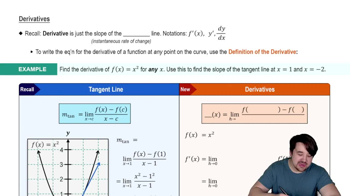
The derivative of a function represents the rate of change of the function with respect to a variable. In the context of particle motion, the derivative of the position function s(t) with respect to time t gives the velocity function v(t). This is crucial for determining when the particle changes direction, which affects the total distance traveled.
Recommended video:
05:44
Derivatives

Critical Points

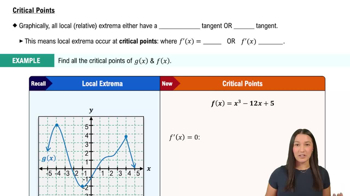
Critical points occur where the derivative of a function is zero or undefined. For motion along a line, these points indicate where the velocity is zero, meaning the particle changes direction. Identifying these points within the given interval helps in calculating the total distance traveled by considering the absolute value of displacement over each segment.
Recommended video:
04:50
Critical Points

Total Distance Traveled

The total distance traveled by a particle is the sum of the absolute values of its displacements over each interval where it moves in a consistent direction. This involves evaluating the position function at critical points and endpoints, ensuring that changes in direction are accounted for by summing the absolute values of each segment's displacement.
Recommended video:
06:22
Introduction To Work
Related Practice
Textbook Question

Motion Along a Coordinate Line


Exercises 1–6 give the positions s = f(t) of a body moving on a coordinate line, with s in meters and t in seconds.


c. When, if ever, during the interval does the body change direction?


s = 25/(t + 5), −4 ≤ t ≤ 0

Textbook Question

Suppose that the functions f and g and their derivatives with respect to x have the following values at x = 0 and x = 1.


" style="max-width: 100%; white-space-collapse: preserve;" width="250">


Find the derivatives with respect to x of the following combinations at the given value of x.


c. f(x) / (g(x) + 1), x = 1

Textbook Question

Differentiability and Continuity on an Interval


Each figure in Exercises 45–50 shows the graph of a function over a closed interval D. At what domain points does the function appear to be


c. neither continuous nor differentiable?


Give reasons for your answers.


Textbook Question

Suppose that functions ƒ(x) and g(x) and their first derivatives have the following values at x = 0 and x = 1.


x ƒ(x) g(x) ƒ'(x) g'(x)

0 1 1 -3 1/2

1 3 5 1/2 -4


Find the first derivatives of the following combinations at the given value of x.


c. ƒ(x) , x = 1

g(x) + 1

Textbook Question

Diagonals If x, y, and z are lengths of the edges of a rectangular box, then the common length of the box’s diagonals is s = √(x² + y² + z²).

c. How are dx/dt, dy/dt, and dz/dt related if s is constant?

Textbook Question

Differentiability and Continuity on an Interval


Each figure in Exercises 45–50 shows the graph of a function over a closed interval D. At what domain points does the function appear to be


c. neither continuous nor differentiable?


Give reasons for your answers.