Ch. 10 - Infinite Sequences and Series
Hass - Thomas' Calculus 15th Edition
Hass15th EditionThomas' CalculusISBN: 9780137616077Not the one you use?Change textbook
Chapter 10, Problem 10.4.69

In Exercises 67–72, use the results of Exercises 63 and 64 to determine if each series converges or diverges.
∑(from n=2 to ∞) [(ln n)¹⁰⁰⁰ / n¹.⁰⁰¹]

Verified step by step guidance
1
Identify the general term of the series: \(a_n = \frac{(\ln n)^{1000}}{n^{1.001}}\) for \(n \geq 2\).
Recall the p-series test: a series of the form \(\sum \frac{1}{n^p}\) converges if and only if \(p > 1\). Here, the denominator has \(n^{1.001}\), which suggests a p-series with \(p = 1.001 > 1\).
Consider the numerator \((\ln n)^{1000}\), which grows slower than any positive power of \(n\). This means the logarithmic term grows slower than any polynomial term in the denominator.
Use the Comparison Test or Limit Comparison Test by comparing \(a_n\) with \(b_n = \frac{1}{n^{1.001}}\). Since \(\lim_{n \to \infty} \frac{a_n}{b_n} = \lim_{n \to \infty} (\ln n)^{1000}\), which tends to infinity, the direct comparison test is inconclusive, so use the Limit Comparison Test carefully.
Apply the Limit Comparison Test with \(b_n = \frac{1}{n^{1.001}}\). Compute \(\lim_{n \to \infty} \frac{a_n}{b_n} = \lim_{n \to \infty} (\ln n)^{1000}\). Since this limit is infinite, the Limit Comparison Test suggests that \(a_n\) behaves like a larger term than \(b_n\), but since \(b_n\) converges, check if the logarithmic growth affects convergence by using the Integral Test or Cauchy Condensation Test.

Verified video answer for a similar problem:

This video solution was recommended by our tutors as helpful for the problem above.
Video duration:
3m
Was this helpful?

Key Concepts

Here are the essential concepts you must grasp in order to answer the question correctly.

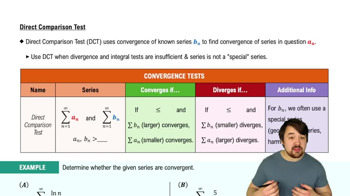
Comparison Test for Series

The Comparison Test helps determine convergence by comparing a given series to a second series whose behavior is known. If the terms of the given series are smaller than those of a convergent series, it also converges. Conversely, if the terms are larger than those of a divergent series, it diverges.
Recommended video:
09:25
Direct Comparison Test

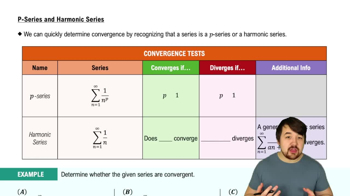
Behavior of p-Series

A p-series is of the form ∑ 1/n^p. It converges if p > 1 and diverges if p ≤ 1. Understanding this helps analyze series with terms involving powers of n, especially when combined with logarithmic factors.
Recommended video:
04:30
P-Series and Harmonic Series

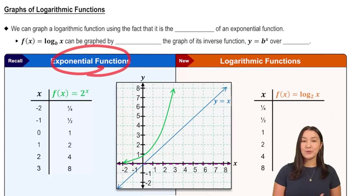
Growth Rates of Logarithmic vs. Polynomial Functions

Logarithmic functions grow slower than any positive power of n. When combined in series terms like (ln n)^k / n^p, the polynomial denominator dominates for large n if p > 1, often leading to convergence despite the logarithmic numerator.
Recommended video:
5:26
Graphs of Logarithmic Functions