
Textbook Question
Determining Convergence or Divergence
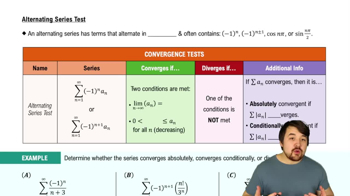
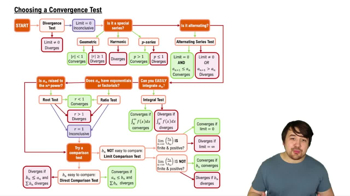
In Exercises 17–46, use any method to determine whether the series converges or diverges. Give reasons for your answer.
∑(from n=1 to ∞) [(-1)ⁿ n² e⁻ⁿ]

 Verified step by step guidance
 10:54
10:54
 07:51
07:51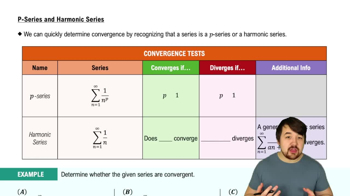 04:30
04:30Determining Convergence or Divergence
In Exercises 17–46, use any method to determine whether the series converges or diverges. Give reasons for your answer.
∑(from n=1 to ∞) [(-1)ⁿ n² e⁻ⁿ]
Finding Taylor Polynomials
In Exercises 1–10, find the Taylor polynomials of orders 0, 1, 2, and 3 generated by f at a.
f(x) = √(1 − x),a = 0
Convergence and Divergence
Which of the sequences {aₙ} in Exercises 31–100 converge, and which diverge? Find the limit of each convergent sequence.
aₙ = 2 + (0.1)ⁿ
Convergence or Divergence
Which of the series in Exercises 57–64 converge, and which diverge? Give reasons for your answers.
∑ (from n = 1 to ∞) [(-1)ⁿ (n!)ⁿ] / [n^(n²)]
In Exercises 53–56, determine how many terms should be used to estimate the sum of the entire series with an error of less than 0.001.
∑ (from n = 1 to ∞) [(-1)ⁿ⁺¹ (n / (n² + 1))]
In Exercises 67–72, use the results of Exercises 63 and 64 to determine if each series converges or diverges.
∑(from n=2 to ∞) [(ln n)¹⁰⁰⁰ / n¹.⁰⁰¹]