Ch. 4 - Applications of the Derivative
Briggs - Calculus: Early Transcendentals 3rd Edition
Briggs3rd EditionCalculus: Early TranscendentalsISBN: 9780136847243Not the one you use?Change textbook
Chapter 4, Problem 4.1.75a

Maximizing profit Suppose a tour guide has a bus that holds a maximum of 100 people. Assume his profit (in dollars) for taking people on a city tour is P(n) = n(50 - 0.5n) - 100. (Although P is defined only for positive integers, treat it as a continuous function.)


a. How many people should the guide take on a tour to maximize the profit?

Verified step by step guidance
1
First, identify the function that represents the profit, which is given as \( P(n) = n(50 - 0.5n) - 100 \). This is a quadratic function in terms of \( n \).
To find the number of people that maximizes the profit, we need to find the critical points of the function. Start by taking the derivative of \( P(n) \) with respect to \( n \).
The derivative \( P'(n) \) can be found using the power rule and the constant rule. Calculate \( P'(n) = \frac{d}{dn}[n(50 - 0.5n) - 100] \).
Set the derivative \( P'(n) \) equal to zero to find the critical points: \( P'(n) = 0 \). Solve this equation for \( n \) to find the value that maximizes the profit.
After finding the critical point, verify that it is a maximum by using the second derivative test or by analyzing the sign changes of \( P'(n) \) around the critical point. Ensure that \( n \) is within the feasible range (0 to 100) for the problem.

Verified video answer for a similar problem:

This video solution was recommended by our tutors as helpful for the problem above.
Video duration:
2m
Was this helpful?

Key Concepts

Here are the essential concepts you must grasp in order to answer the question correctly.

Profit Function

The profit function P(n) = n(50 - 0.5n) - 100 represents the relationship between the number of people n on a tour and the profit generated. It is a quadratic function, where the profit depends on the number of attendees, accounting for both revenue and costs. Understanding this function is crucial for determining how changes in n affect profit.
Recommended video:
07:32
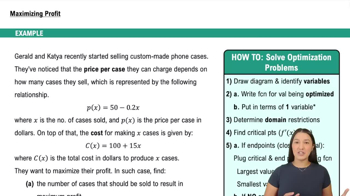
Example 3: Maximizing Profit

Maximization of Functions

Maximizing a function involves finding the input value that yields the highest output. In this context, we need to find the value of n that maximizes the profit function P(n). This typically involves taking the derivative of the function, setting it to zero, and solving for n to find critical points, which can indicate maximum profit.
Recommended video:
04:18
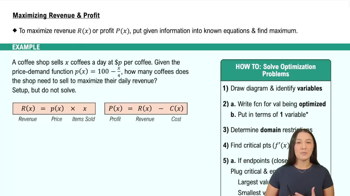
Maximizing Profit & Revenue

Critical Points and Second Derivative Test

Critical points occur where the first derivative of a function is zero or undefined, indicating potential maxima or minima. To confirm whether a critical point is a maximum, the second derivative test can be applied. If the second derivative is negative at a critical point, it indicates a local maximum, which is essential for determining the optimal number of tour participants.
Recommended video:
06:02
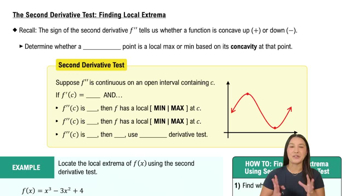
The Second Derivative Test: Finding Local Extrema
Related Practice
Textbook Question

Explain why or why not Determine whether the following statements are true and give an explanation or counterexample.


a. F(x) = x³ - 4x + 100 and G(x) = x³ - 4x - 100 are antiderivatives of the same function.

Textbook Question

Optimal soda can


a. Classical problem Find the radius and height of a cylindrical soda can with a volume of 354 cm³ that minimize the surface area.

Textbook Question

Rectangles beneath a line


a. A rectangle is constructed with one side on the positive x-axis, one side on the positive y-axis, and the vertex opposite the origin on the line y = 10 - 2x. What dimensions maximize the area of the rectangle? What is the maximum area?

Textbook Question

Explain why or why not Determine whether the following statements are true and give an explanation or counterexample.


a. The function f(x) = √x has a local maximum on the interval [0,∞).

Textbook Question

107–110. {Use of Tech} Motion with gravity Consider the following descriptions of the vertical motion of an object subject only to the acceleration due to gravity. Begin with the acceleration equation a(t) = v' (t) = -g , where g = 9.8 m/s² .

a. Find the velocity of the object for all relevant times. 

A payload is released at an elevation of 400 m from a hot-air balloon that is rising at a rate of 10 m/s.

1
views
Textbook Question

{Use of Tech} Fixed points of quadratics and quartics Let f(x) = ax(1 -x), where a is a real number and 0 ≤ a ≤ 1. Recall that the fixed point of a function is a value of x such that f(x) = x (Exercises 48–51). 


a. Without using a calculator, find the values of a, with 0 ≤ a ≤ 4, such that f  has a fixed point. Give the fixed point in terms of a.