Ch. 4 - Applications of the Derivative
Briggs - Calculus: Early Transcendentals 3rd Edition
Briggs3rd EditionCalculus: Early TranscendentalsISBN: 9780136847243Not the one you use?Change textbook
Chapter 4, Problem 4.8.58a

{Use of Tech} Fixed points of quadratics and quartics Let f(x) = ax(1 -x), where a is a real number and 0 ≤ a ≤ 1. Recall that the fixed point of a function is a value of x such that f(x) = x (Exercises 48–51). 


a. Without using a calculator, find the values of a, with 0 ≤ a ≤ 4, such that f  has a fixed point. Give the fixed point in terms of a. 

Verified step by step guidance
1
Start by setting up the equation for a fixed point. A fixed point of the function f(x) = ax(1 - x) is a value of x such that f(x) = x. Therefore, set ax(1 - x) = x.
Rearrange the equation ax(1 - x) = x to form a quadratic equation. This can be done by expanding the left side to get ax - ax^2 = x, and then moving all terms to one side: ax - ax^2 - x = 0.
Factor the quadratic equation ax - ax^2 - x = 0. Start by factoring out x from the terms: x(a - ax - 1) = 0. This gives two potential solutions: x = 0 or a - ax - 1 = 0.
Solve the equation a - ax - 1 = 0 for x. Rearrange it to find x in terms of a: ax = a - 1, which simplifies to x = (a - 1)/a, provided a ≠ 0.
Determine the values of a for which the fixed points are valid. Since 0 ≤ a ≤ 4, check the conditions for x = 0 and x = (a - 1)/a to be valid fixed points. Note that x = 0 is always a fixed point, and x = (a - 1)/a is valid when a > 1.

Verified video answer for a similar problem:

This video solution was recommended by our tutors as helpful for the problem above.
Video duration:
2m
Was this helpful?

Key Concepts

Here are the essential concepts you must grasp in order to answer the question correctly.

Fixed Points

A fixed point of a function f(x) is a value x such that f(x) = x. This means that when the function is applied to this value, it returns the same value. Finding fixed points often involves solving the equation f(x) - x = 0. In the context of the given function, identifying fixed points helps determine the values of a for which the function intersects the line y = x.
Recommended video:
04:50
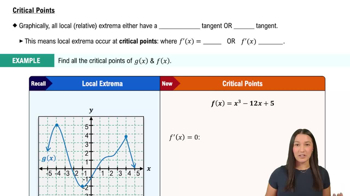
Critical Points

Quadratic Functions

Quadratic functions are polynomial functions of degree two, typically expressed in the form f(x) = ax^2 + bx + c. In this case, the function f(x) = ax(1 - x) can be expanded to a quadratic form, which allows for the analysis of its properties, such as its vertex, axis of symmetry, and roots. Understanding the behavior of quadratics is essential for finding fixed points and analyzing their stability.
Recommended video:
6:04
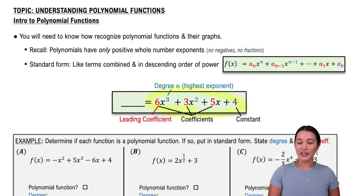
Introduction to Polynomial Functions

Parameter Variation

Parameter variation involves changing the values of parameters in a function to observe how the function's behavior changes. In this problem, the parameter a affects the shape and position of the quadratic function f(x). By varying a within the specified range (0 ≤ a ≤ 4), we can determine how many fixed points exist and their corresponding values, which is crucial for solving the problem.
Recommended video:
03:52
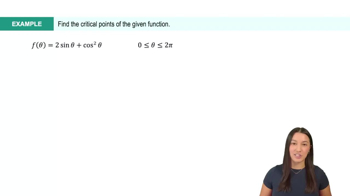
Critical Points Example 2
Related Practice
Textbook Question

Explain why or why not Determine whether the following statements are true and give an explanation or counterexample.


a. F(x) = x³ - 4x + 100 and G(x) = x³ - 4x - 100 are antiderivatives of the same function.

Textbook Question

{Use of Tech} A damped oscillator The displacement of an object as it bounces vertically up and down on a spring is given by y(t) = 2.5e⁻ᵗ cos 2t, where the initial displacement is y(0) = 2.5 and y = 0 corresponds to the rest position (see figure). <IMAGE>

a. Find the time at which the object first passes the rest position, y = 0. 

Textbook Question

Optimal soda can


a. Classical problem Find the radius and height of a cylindrical soda can with a volume of 354 cm³ that minimize the surface area.

Textbook Question

Rectangles beneath a line


a. A rectangle is constructed with one side on the positive x-axis, one side on the positive y-axis, and the vertex opposite the origin on the line y = 10 - 2x. What dimensions maximize the area of the rectangle? What is the maximum area?

Textbook Question

Maximizing profit Suppose a tour guide has a bus that holds a maximum of 100 people. Assume his profit (in dollars) for taking people on a city tour is P(n) = n(50 - 0.5n) - 100. (Although P is defined only for positive integers, treat it as a continuous function.)


a. How many people should the guide take on a tour to maximize the profit?

Textbook Question

107–110. {Use of Tech} Motion with gravity Consider the following descriptions of the vertical motion of an object subject only to the acceleration due to gravity. Begin with the acceleration equation a(t) = v' (t) = -g , where g = 9.8 m/s² .

a. Find the velocity of the object for all relevant times. 

A payload is released at an elevation of 400 m from a hot-air balloon that is rising at a rate of 10 m/s.

1
views