Ch. 3 - Derivatives
Briggs - Calculus: Early Transcendentals 3rd Edition
Briggs3rd EditionCalculus: Early TranscendentalsISBN: 9780136847243Not the one you use?Change textbook
Chapter 3, Problem 43

Derivative calculations Evaluate the derivative of the following functions at the given point.
f(t) = 1/t+1; a=1

Verified step by step guidance
1
Step 1: Identify the function f(t) = \(\frac{1}{t}\) + 1 and the point a = 1 where we need to evaluate the derivative.
Step 2: Rewrite the function in a form that is easier to differentiate: f(t) = t^{-1} + 1.
Step 3: Differentiate the function using the power rule. The derivative of t^{-1} is -t^{-2}, and the derivative of a constant (1) is 0.
Step 4: Combine the results from the differentiation: f'(t) = -t^{-2}.
Step 5: Evaluate the derivative at the given point a = 1: f'(1) = -1^{-2}.

Verified video answer for a similar problem:

This video solution was recommended by our tutors as helpful for the problem above.
Video duration:
3m
Was this helpful?

Key Concepts

Here are the essential concepts you must grasp in order to answer the question correctly.

Derivative

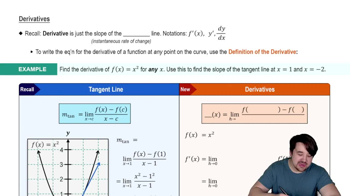
The derivative of a function measures how the function's output value changes as its input value changes. It is defined as the limit of the average rate of change of the function over an interval as the interval approaches zero. In practical terms, the derivative provides the slope of the tangent line to the function's graph at a given point.
Recommended video:
05:44
Derivatives

Limit

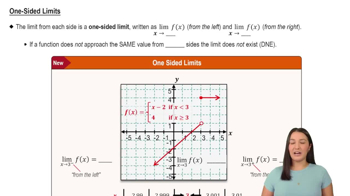
A limit is a fundamental concept in calculus that describes the behavior of a function as its input approaches a certain value. It is essential for defining derivatives and integrals. Understanding limits allows us to analyze functions that may not be well-defined at specific points, enabling the calculation of derivatives even when direct substitution is not possible.
Recommended video:
05:50
One-Sided Limits

Function Evaluation

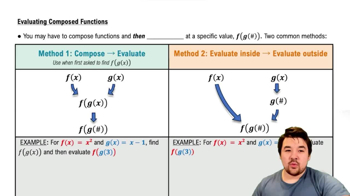
Function evaluation involves substituting a specific value into a function to determine its output. In the context of derivatives, evaluating the function at a particular point is crucial for finding the derivative at that point. This process often requires simplifying the function and applying the rules of calculus to derive the correct output.
Recommended video:
4:26
Evaluating Composed Functions