Ch. 3 - Derivatives
Briggs - Calculus: Early Transcendentals 3rd Edition
Briggs3rd EditionCalculus: Early TranscendentalsISBN: 9780136847243Not the one you use?Change textbook
Chapter 3, Problem 46

Derivatives of products and quotients Find the derivative of the following functions by first expanding or simplifying the expression. Simplify your answers. 
f(x) = (√x+1)(√x-1)

Verified step by step guidance
1
Step 1: Recognize that the function \( f(x) = (\sqrt{x} + 1)(\sqrt{x} - 1) \) is a product of two binomials. This expression can be expanded using the difference of squares formula, \((a+b)(a-b) = a^2 - b^2\).
Step 2: Apply the difference of squares formula to expand the expression: \((\sqrt{x} + 1)(\sqrt{x} - 1) = (\sqrt{x})^2 - 1^2\).
Step 3: Simplify the expanded expression: \((\sqrt{x})^2 = x\) and \(1^2 = 1\), so the expression becomes \(x - 1\).
Step 4: Now that the function is simplified to \(f(x) = x - 1\), find the derivative using basic differentiation rules. The derivative of \(x\) with respect to \(x\) is 1, and the derivative of a constant \(-1\) is 0.
Step 5: Combine the derivatives to find \(f'(x)\). Since the derivative of \(x - 1\) is \(1 - 0\), the derivative \(f'(x)\) is simply 1.

Verified video answer for a similar problem:

This video solution was recommended by our tutors as helpful for the problem above.
Video duration:
2m
Was this helpful?

Key Concepts

Here are the essential concepts you must grasp in order to answer the question correctly.

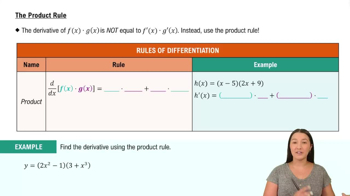
Product Rule

The Product Rule is a fundamental principle in calculus used to find the derivative of the product of two functions. It states that if you have two functions, u(x) and v(x), the derivative of their product is given by f'(x) = u'v + uv'. This rule is essential when dealing with functions that are multiplied together, as it allows for the differentiation of each component function while maintaining their relationship.
Recommended video:
05:18
The Product Rule

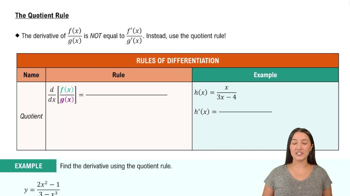
Quotient Rule

The Quotient Rule is another important rule in calculus for finding the derivative of a quotient of two functions. If you have a function defined as f(x) = u(x)/v(x), the derivative is given by f'(x) = (u'v - uv')/v^2. This rule is crucial when differentiating functions that are expressed as a ratio, ensuring that both the numerator and denominator are appropriately accounted for in the differentiation process.
Recommended video:
06:43
The Quotient Rule

Simplification of Expressions

Simplification of expressions involves rewriting a mathematical expression in a more manageable or understandable form. In the context of derivatives, simplifying an expression before differentiation can make the process easier and the results clearer. For example, expanding products or combining like terms can help eliminate complex fractions or roots, making it simpler to apply differentiation rules effectively.
Recommended video:
6:36
Simplifying Trig Expressions