Ch. 3 - Derivatives
Briggs - Calculus: Early Transcendentals 3rd Edition
Briggs3rd EditionCalculus: Early TranscendentalsISBN: 9780136847243Not the one you use?Change textbook
Chapter 3, Problem 42b

Fish length Assume the length L (in centimeters) of a particular species of fish after t years is modeled by the following graph. <IMAGE>
b. What does the derivative tell you about how this species of fish grows?

Verified step by step guidance
1
Step 1: Understand the concept of a derivative in this context. The derivative of a function at a given point provides the rate of change of the function's value with respect to its input. In this case, the derivative of the length function L(t) with respect to time t, denoted as L'(t), represents the rate at which the fish's length is changing at any given time.
Step 2: Consider the biological interpretation. The derivative L'(t) tells us how fast the fish is growing at any particular time t. A positive derivative indicates that the fish is growing, while a negative derivative would suggest the fish is shrinking, which is biologically unlikely in this context.
Step 3: Analyze the graph of L(t). Look for key features such as where the graph is increasing, decreasing, or constant. These features will help you understand the behavior of the derivative. For example, if the graph is steep, the derivative is large, indicating rapid growth.
Step 4: Identify any points of interest on the graph, such as where the slope changes. These could be points where the growth rate changes, such as a maximum growth rate or a point where growth slows down.
Step 5: Summarize the growth pattern. Based on the graph and the behavior of the derivative, describe how the fish's growth rate changes over time. This could include periods of rapid growth, slowing growth, or reaching a maximum size.

Verified video answer for a similar problem:

This video solution was recommended by our tutors as helpful for the problem above.
Video duration:
3m
Was this helpful?

Key Concepts

Here are the essential concepts you must grasp in order to answer the question correctly.

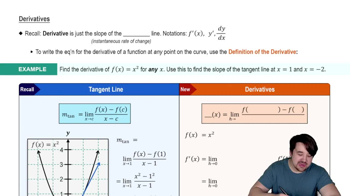
Derivative

The derivative of a function represents the rate of change of that function with respect to its variable. In the context of the fish length model, the derivative indicates how the length of the fish changes over time, providing insights into the growth rate at any given moment.
Recommended video:
05:44
Derivatives

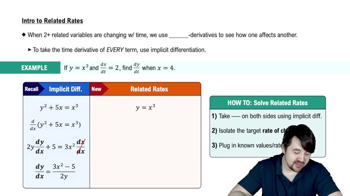
Growth Rate

The growth rate refers to the speed at which a quantity increases over time. For the fish species in question, the growth rate can be determined by evaluating the derivative of the length function, revealing whether the fish are growing faster or slower as they age.
Recommended video:
04:16
Intro To Related Rates

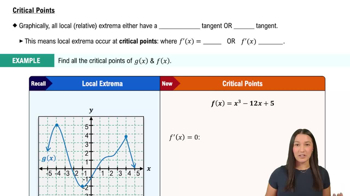
Inflection Points

Inflection points occur where the curvature of a function changes, indicating a shift in the growth behavior. In the context of fish growth, identifying inflection points in the derivative can help determine periods of accelerated or decelerated growth, which are crucial for understanding the species' development.
Recommended video:
04:50
Critical Points