Ch. 3 - Derivatives
Briggs - Calculus: Early Transcendentals 3rd Edition
Briggs3rd EditionCalculus: Early TranscendentalsISBN: 9780136847243Not the one you use?Change textbook
Chapter 3, Problem 3.5.78

Match the graphs of the functions in a–d with the graphs of their derivatives in A–D. <MATCH A-D IMAGE>

Verified step by step guidance
1
Step 1: Understand the relationship between a function and its derivative. The derivative of a function represents the rate of change or the slope of the function at any given point.
Step 2: Analyze the graphs of the functions a–d. Look for key features such as increasing or decreasing behavior, and points where the slope is zero (horizontal tangent lines).
Step 3: Examine the graphs of the derivatives A–D. Identify characteristics such as positive or negative values, which indicate whether the original function is increasing or decreasing, and zero values, which correspond to points where the original function has a horizontal tangent.
Step 4: Match each function graph with its derivative graph by comparing the behavior of the function with the corresponding derivative. For example, if a function is increasing, its derivative should be positive; if a function has a maximum or minimum point, its derivative should be zero at that point.
Step 5: Verify your matches by checking that the derivative graph accurately reflects the changes in slope of the original function graph across different intervals.

Verified video answer for a similar problem:

This video solution was recommended by our tutors as helpful for the problem above.
Video duration:
10m
Was this helpful?

Key Concepts

Here are the essential concepts you must grasp in order to answer the question correctly.

Function and Derivative Relationship

The derivative of a function measures the rate at which the function's value changes as its input changes. Graphically, the derivative represents the slope of the tangent line to the function's graph at any given point. Understanding this relationship is crucial for matching functions with their derivatives, as the behavior of the function (increasing, decreasing, or constant) directly influences the shape of its derivative graph.
Recommended video:
06:30
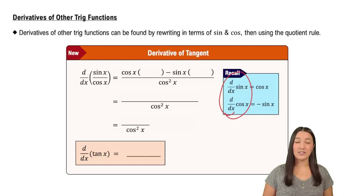
Derivatives of Other Trig Functions

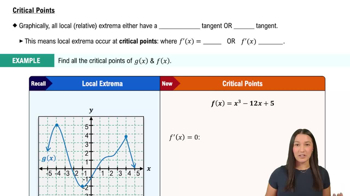
Critical Points

Critical points occur where the derivative of a function is zero or undefined. These points are significant because they indicate potential local maxima, minima, or points of inflection on the function's graph. Identifying critical points helps in understanding the overall behavior of the function and is essential for accurately matching it with its derivative, as the derivative graph will show changes in sign at these points.
Recommended video:
04:50
Critical Points

Graphical Interpretation of Derivatives

The graphical interpretation of derivatives involves analyzing how the slope of the function changes across its domain. For instance, where the function is increasing, the derivative will be positive, and where it is decreasing, the derivative will be negative. Additionally, the points where the derivative crosses the x-axis correspond to the critical points of the original function, making it vital to recognize these patterns when matching graphs.
Recommended video:
01:47
Graphical Applications of Exponential & Logarithmic Derivatives: Example 8