Match the graphs of the functions in a–d with the graphs of their derivatives in A–D. <MATCH A-D IMAGE>

Ch. 3 - Derivatives
Briggs3rd EditionCalculus: Early TranscendentalsISBN: 9780136847243Not the one you use?Change textbook
Chapter 3, Problem 3.1.58
Find the function The following limits represent the slope of a curve y = f(x) at the point (a,f(a)). Determine a possible function f and number a; then calculate the limit.
(lim x🠂2) 1/x+1 - 1/3 / x-2
Verified step by step guidance1
Step 1: Recognize that the given limit represents the derivative of a function at a point. The expression \( \lim_{{x \to 2}} \frac{\frac{1}{x+1} - \frac{1}{3}}{x-2} \) is in the form of the definition of the derivative \( f'(a) = \lim_{{x \to a}} \frac{f(x) - f(a)}{x-a} \).
Step 2: Identify the function \( f(x) \) and the point \( a \). From the expression \( \frac{1}{x+1} \), we can deduce that \( f(x) = \frac{1}{x+1} \). The point \( a \) is given by the limit \( x \to 2 \), so \( a = 2 \).
Step 3: Calculate \( f(a) \). Substitute \( a = 2 \) into \( f(x) \) to find \( f(2) = \frac{1}{2+1} = \frac{1}{3} \). This matches the \( \frac{1}{3} \) in the limit expression, confirming our function and point.
Step 4: Set up the derivative calculation. The derivative \( f'(x) \) is given by \( \lim_{{x \to 2}} \frac{f(x) - f(2)}{x-2} = \lim_{{x \to 2}} \frac{\frac{1}{x+1} - \frac{1}{3}}{x-2} \).
Step 5: Simplify the expression to find the limit. Combine the fractions in the numerator: \( \frac{1}{x+1} - \frac{1}{3} = \frac{3 - (x+1)}{3(x+1)} = \frac{2-x}{3(x+1)} \). Substitute this back into the limit: \( \lim_{{x \to 2}} \frac{\frac{2-x}{3(x+1)}}{x-2} \). Simplify and evaluate the limit.

Verified video answer for a similar problem:
This video solution was recommended by our tutors as helpful for the problem above.
Video duration:
6mWas this helpful?
Key Concepts
Here are the essential concepts you must grasp in order to answer the question correctly.
Limits
Limits are fundamental in calculus, representing the value that a function approaches as the input approaches a certain point. In this context, the limit helps determine the slope of the curve at a specific point, which is essential for understanding the behavior of the function near that point.
Recommended video:
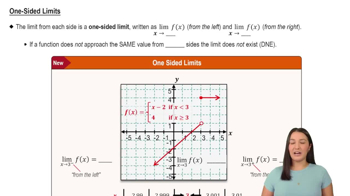
One-Sided Limits
Derivatives
The derivative of a function at a point gives the slope of the tangent line to the curve at that point. It is defined as the limit of the average rate of change of the function as the interval approaches zero. In this problem, finding the derivative at the point (a, f(a)) is crucial for determining the slope of the curve.
Recommended video:
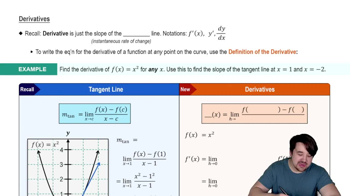
Derivatives
Rational Functions
Rational functions are ratios of polynomials, and they often require careful analysis when evaluating limits, especially when approaching points where the function may be undefined. In this question, the limit involves a rational expression, and understanding how to simplify or manipulate such expressions is key to finding the desired limit.
Recommended video:
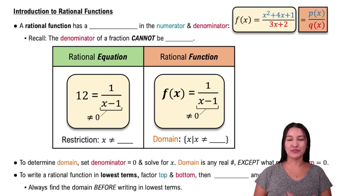
Intro to Rational Functions
Related Practice
Textbook Question
Textbook Question
23–51. Calculating derivatives Find the derivative of the following functions.
y = a sin x + b cos x/a sin x - b cos x; a and b are nonzero constants
Textbook Question
49–55. Derivatives of tower functions (or g^h) Find the derivative of each function and evaluate the derivative at the given value of a.
g (x) = x^ In x; a = e
Textbook Question
75–86. Logarithmic differentiation Use logarithmic differentiation to evaluate f'(x).
f(x) = x⁸cos³ x / √x-1
2
views
Textbook Question
Find and simplify the derivative of the following functions.
f(x) = ex(x3 − 3x2 + 6x − 6)
Textbook Question
47–56. Derivatives of inverse functions at a point Consider the following functions. In each case, without finding the inverse, evaluate the derivative of the inverse at the given point.
f(x) = 1/2x+8; (10,4)