Ch. 3 - Derivatives
Briggs - Calculus: Early Transcendentals 3rd Edition
Briggs3rd EditionCalculus: Early TranscendentalsISBN: 9780136847243Not the one you use?Change textbook
Chapter 3, Problem 3.5.32

23–51. Calculating derivatives Find the derivative of the following functions.
y = a sin x + b cos x/a sin x - b cos x; a and b are nonzero constants

Verified step by step guidance
1
Step 1: Identify the function for which you need to find the derivative. The function given is \( y = \frac{a \sin x + b \cos x}{a \sin x - b \cos x} \).
Step 2: Recognize that this is a quotient of two functions, so you will need to use the Quotient Rule for differentiation. The Quotient Rule states that if you have a function \( y = \frac{u(x)}{v(x)} \), then the derivative \( y' \) is given by \( y' = \frac{u'(x)v(x) - u(x)v'(x)}{(v(x))^2} \).
Step 3: Identify \( u(x) = a \sin x + b \cos x \) and \( v(x) = a \sin x - b \cos x \). Compute the derivatives \( u'(x) \) and \( v'(x) \). Use the derivatives of sine and cosine: \( \frac{d}{dx}(\sin x) = \cos x \) and \( \frac{d}{dx}(\cos x) = -\sin x \).
Step 4: Calculate \( u'(x) = a \cos x - b \sin x \) and \( v'(x) = a \cos x + b \sin x \).
Step 5: Substitute \( u(x) \), \( v(x) \), \( u'(x) \), and \( v'(x) \) into the Quotient Rule formula to find the derivative of \( y \). Simplify the expression if possible.

Verified video answer for a similar problem:

This video solution was recommended by our tutors as helpful for the problem above.
Video duration:
7m
Was this helpful?

Key Concepts

Here are the essential concepts you must grasp in order to answer the question correctly.

Derivatives

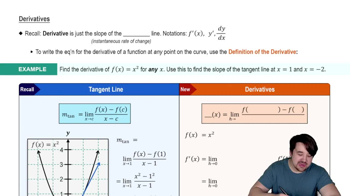
A derivative represents the rate of change of a function with respect to its variable. It is a fundamental concept in calculus that allows us to determine how a function behaves at any given point. The derivative can be computed using various rules, such as the power rule, product rule, and quotient rule, depending on the form of the function.
Recommended video:
05:44
Derivatives

Trigonometric Functions

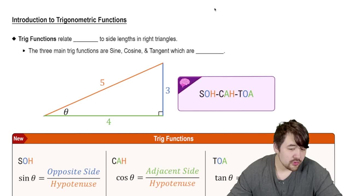
Trigonometric functions, such as sine and cosine, are periodic functions that relate angles to ratios of sides in right triangles. In calculus, these functions are essential for modeling oscillatory behavior and are frequently encountered in problems involving derivatives. Understanding their properties, such as their derivatives, is crucial for solving calculus problems involving these functions.
Recommended video:
6:04
Introduction to Trigonometric Functions

Quotient Rule

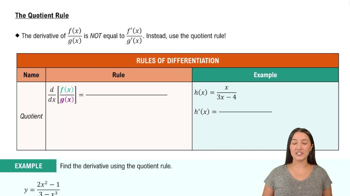
The quotient rule is a method for finding the derivative of a function that is the ratio of two other functions. It states that if you have a function y = u/v, where u and v are both differentiable functions, the derivative is given by (v * u' - u * v') / v^2. This rule is particularly useful when differentiating functions like the one in the question, where the function is expressed as a fraction.
Recommended video:
06:43
The Quotient Rule