Ch. 7 - Transcendental Functions
Hass - Thomas' Calculus 15th Edition
Hass15th EditionThomas' CalculusISBN: 9780137616077Not the one you use?Change textbook
Chapter 7, Problem 7.PE.81

In Exercises 79–84, solve for y.
81. 9e^(2y) = = x^2

Verified step by step guidance
1
Start with the given equation: \(9e^{2y} = x^2\).
Isolate the exponential term by dividing both sides of the equation by 9: \(e^{2y} = \frac{x^2}{9}\).
To solve for \(y\), take the natural logarithm (ln) of both sides to undo the exponential: \(\ln\left(e^{2y}\right) = \ln\left(\frac{x^2}{9}\right)\).
Use the logarithm property \(\ln\left(e^a\right) = a\) to simplify the left side: \(2y = \ln\left(\frac{x^2}{9}\right)\).
Finally, solve for \(y\) by dividing both sides by 2: \(y = \frac{1}{2} \ln\left(\frac{x^2}{9}\right)\).

Verified video answer for a similar problem:

This video solution was recommended by our tutors as helpful for the problem above.
Video duration:
1m
Was this helpful?

Key Concepts

Here are the essential concepts you must grasp in order to answer the question correctly.

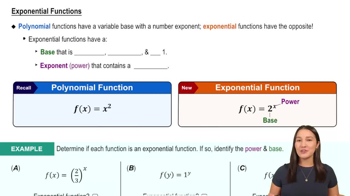
Exponential Functions

An exponential function involves a variable in the exponent, such as e^(2y). Understanding how to manipulate and isolate the variable in the exponent is essential for solving equations involving exponential expressions.
Recommended video:
6:13
Exponential Functions

Logarithmic Functions and Properties

Logarithms are the inverse operations of exponentials. Applying logarithms allows us to solve for variables in the exponent by converting exponential equations into linear ones, making it easier to isolate and solve for y.
Recommended video:
06:21
Properties of Functions

Algebraic Manipulation

Solving for y requires careful algebraic steps, including isolating terms, simplifying expressions, and applying inverse operations. Mastery of algebraic manipulation ensures accurate and efficient problem-solving.
Recommended video:
05:25
Determine Continuity Algebraically