Ch. 7 - Transcendental Functions
Hass - Thomas' Calculus 15th Edition
Hass15th EditionThomas' CalculusISBN: 9780137616077Not the one you use?Change textbook
Chapter 7, Problem 7.PE.64

Evaluate the integrals in Exercises 31–78.
64. ∫(from 1 to e)(8ln3 log_3(θ))/θ dθ

Verified step by step guidance
1
Recognize the integral to evaluate: \(\int_1^e \frac{8 \ln 3 \log_3(\theta)}{\theta} \, d\theta\).
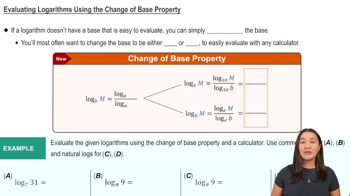
Recall the change of base formula for logarithms: \(\log_3(\theta) = \frac{\ln(\theta)}{\ln(3)}\).
Substitute \(\log_3(\theta)\) in the integral using the change of base formula, so the integrand becomes \(\frac{8 \ln 3 \cdot \frac{\ln(\theta)}{\ln(3)}}{\theta} = \frac{8 \ln(\theta)}{\theta}\) after simplifying \(\ln 3\) terms.
Rewrite the integral as \(\int_1^e \frac{8 \ln(\theta)}{\theta} \, d\theta\) and identify the substitution \(u = \ln(\theta)\), which implies \(du = \frac{1}{\theta} d\theta\).
Express the integral in terms of \(u\): it becomes \(\int_{u=\ln(1)}^{u=\ln(e)} 8u \, du\), then proceed to integrate \$8u\( with respect to \)u$ over the new limits.

Verified video answer for a similar problem:

This video solution was recommended by our tutors as helpful for the problem above.
Video duration:
2m
Was this helpful?

Key Concepts

Here are the essential concepts you must grasp in order to answer the question correctly.

Properties of Logarithms

Understanding the properties of logarithms, such as change of base and the relationship between natural logs and logarithms of other bases, is essential. For example, log base 3 of θ can be expressed using natural logs as ln(θ)/ln(3), which simplifies integration involving different log bases.
Recommended video:
05:36
Change of Base Property

Integration of Logarithmic Functions

Integrating functions involving logarithms often requires techniques like substitution or integration by parts. Recognizing the form of the integrand and applying appropriate methods helps evaluate integrals such as ∫(ln(θ))/θ dθ or similar expressions.
Recommended video:
5:26
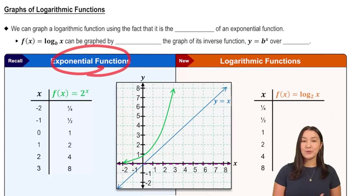
Graphs of Logarithmic Functions

Definite Integrals and Limits of Integration

Evaluating definite integrals involves applying the Fundamental Theorem of Calculus after finding the antiderivative. Understanding how to substitute the upper and lower limits correctly is crucial to obtaining the exact value of the integral over the interval [1, e].
Recommended video:
05:43
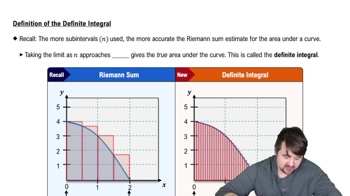
Definition of the Definite Integral