
Ch. 5 - Integration
Briggs - Calculus: Early Transcendentals 3rd Edition
Briggs3rd EditionCalculus: Early TranscendentalsISBN: 9780136847243Not the one you use?Change textbook
Chapter 5, Problem 5.3.66

Area Find (i) the net area and (ii) the area of the following regions. Graph the function and indicate the region in question.


The region bounded by y = 6 cos 𝓍 and the 𝓍-axis between 𝓍 = ―π/2 and 𝓍 = Ο€

Verified step by step guidance
1
Step 1: Understand the problem. You are tasked with finding (i) the net area and (ii) the total area of the region bounded by the function y = 6 cos(𝓍) and the 𝓍-axis between 𝓍 = -Ο€/2 and 𝓍 = Ο€. The net area accounts for signed areas (positive above the 𝓍-axis and negative below), while the total area considers only the magnitude of the regions.
Step 2: Graph the function y = 6 cos(𝓍) over the interval [-Ο€/2, Ο€]. The cosine function oscillates between -1 and 1, and multiplying by 6 scales the amplitude to [-6, 6]. Identify where the function crosses the 𝓍-axis (i.e., where y = 0) within the interval. These points divide the region into subintervals where the function is either positive or negative.
Step 3: Set up the integral for the net area. The net area is calculated using the definite integral of y = 6 cos(𝓍) over the interval [-Ο€/2, Ο€]. Use the formula: a-π/2bπ6cosπ
Step 4: Set up the integral for the total area. To find the total area, you need to integrate the absolute value of y = 6 cos(𝓍) over the interval [-Ο€/2, Ο€]. This requires splitting the integral into subintervals where the function is positive and negative, and then taking the absolute value of the function in the negative subinterval. Use the formula: a-π/2bπ6cosπ
Step 5: Solve the integrals. For the net area, evaluate the definite integral of 6 cos(𝓍) over [-Ο€/2, Ο€]. For the total area, split the integral into subintervals where the function is positive and negative, and evaluate the absolute value of the function in the negative subinterval. Combine the results to find the total area. Ensure proper use of trigonometric identities and integration rules.

Verified video answer for a similar problem:

This video solution was recommended by our tutors as helpful for the problem above.
Video duration:
7m
Was this helpful?

Key Concepts

Here are the essential concepts you must grasp in order to answer the question correctly.

Definite Integral

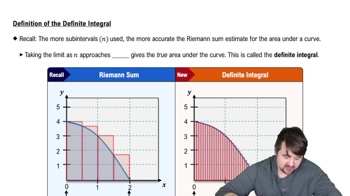
The definite integral is a fundamental concept in calculus that represents the net area under a curve between two specified limits. It is calculated using the integral symbol and provides a way to quantify the accumulation of quantities, such as area, over an interval. In this context, it will be used to find the area between the curve y = 6 cos x and the x-axis from x = -Ο€/2 to x = Ο€.
Recommended video:
05:43
Definition of the Definite Integral

Net Area vs. Total Area

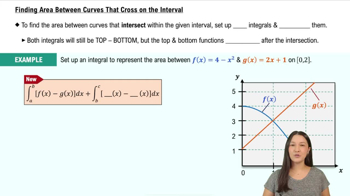
Net area refers to the signed area between a curve and the x-axis, where areas above the x-axis are positive and those below are negative. In contrast, total area considers all areas as positive, regardless of their position relative to the x-axis. Understanding this distinction is crucial for accurately calculating the areas in the given problem, especially since the cosine function oscillates above and below the x-axis.
Recommended video:
02:59
Finding Area Between Curves that Cross on the Interval

Graphing Trigonometric Functions

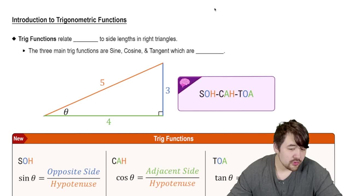
Graphing trigonometric functions, such as y = 6 cos x, involves plotting the function's values over a specified interval to visualize its behavior. This includes identifying key features like amplitude, period, and intercepts. For this problem, graphing the function will help in understanding the regions bounded by the curve and the x-axis, which is essential for determining both the net and total areas.
Recommended video:
6:04
Introduction to Trigonometric Functions
Related Practice
Textbook Question

Approximating displacement The velocity of an object is given by the following functions on a specified interval. Approximate the displacement of the object on this interval by subdividing the interval into n subintervals. Use the left endpoint of each subinterval to compute the height of the rectangles.

v = [1 / (2t + 1)] (m/s), for 0 ≀ t ≀ 8 ; n = 4

Textbook Question

Average value of the derivative Suppose Ζ’ ' is a continuous function for all real numbers. Show that the average value of the derivative on an interval [a, b] is ƒ⁻' = (Ζ’(b) ―ƒ(a))/ (b―a) . Interpret this result in terms of secant lines.

Textbook Question

General results Evaluate the following integrals in which the function Ζ’ is unspecified. Note that ƒ⁽ᡖ⁾ is the pth derivative of Ζ’ and Ζ’α΅– is the pth power of Ζ’. Assume Ζ’ and its derivatives are continuous for all real numbers. 

∫ (5 Ζ’Β³ (𝓍) + 7Ζ’Β² (𝓍) + Ζ’ (𝓍 )) Ζ’'(𝓍) d𝓍

Textbook Question

Variations on the substitution method Evaluate the following integrals.                                                                                                        


 βˆ« yΒ²/(y + 1)⁴ dy

Textbook Question

Average distance on a parabola What is the average distance between the parabola y = 30𝓍 (20 ― 𝓍 ) and the 𝓍-axis on the interval [0, 20] ?

Textbook Question

Approximating displacement The velocity of an object is given by the following functions on a specified interval. Approximate the displacement of the object on this interval by subdividing the interval into n subintervals. Use the left endpoint of each subinterval to compute the height of the rectangles.

v = 2t + 1(m/s), for 0 ≀ t ≀ 8 ; n = 2

1
views