Ch. 5 - Integration
Briggs - Calculus: Early Transcendentals 3rd Edition
Briggs3rd EditionCalculus: Early TranscendentalsISBN: 9780136847243Not the one you use?Change textbook
Chapter 5, Problem 5.1.17

Approximating displacement The velocity of an object is given by the following functions on a specified interval. Approximate the displacement of the object on this interval by subdividing the interval into n subintervals. Use the left endpoint of each subinterval to compute the height of the rectangles.
v = 2t + 1(m/s), for 0 ≤ t ≤ 8 ; n = 2

Verified step by step guidance
1
Step 1: Understand the problem. The goal is to approximate the displacement of the object over the interval [0, 8] using the velocity function v = 2t + 1. The interval is subdivided into n = 2 subintervals, and the left endpoint of each subinterval is used to compute the height of the rectangles.
Step 2: Divide the interval [0, 8] into n = 2 subintervals. The width of each subinterval (Δt) is calculated as Δt = (8 - 0) / 2 = 4. So the subintervals are [0, 4] and [4, 8].
Step 3: Determine the left endpoints of each subinterval. For the subinterval [0, 4], the left endpoint is t = 0. For the subinterval [4, 8], the left endpoint is t = 4.
Step 4: Evaluate the velocity function v = 2t + 1 at each left endpoint. For t = 0, v(0) = 2(0) + 1 = 1. For t = 4, v(4) = 2(4) + 1 = 9.
Step 5: Approximate the displacement by summing the areas of the rectangles. The area of each rectangle is given by height × width. For the first rectangle, the area is v(0) × Δt = 1 × 4. For the second rectangle, the area is v(4) × Δt = 9 × 4. Add these areas together to approximate the total displacement.

Verified video answer for a similar problem:

This video solution was recommended by our tutors as helpful for the problem above.
Video duration:
3m
Was this helpful?

Key Concepts

Here are the essential concepts you must grasp in order to answer the question correctly.

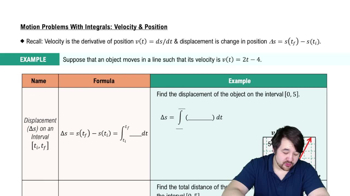
Velocity and Displacement

Velocity is the rate of change of displacement with respect to time. In this context, the velocity function v(t) = 2t + 1 describes how the object's speed changes over time. Displacement can be approximated by integrating the velocity function over a specified interval, which gives the total change in position of the object.
Recommended video:
10:17
Using The Velocity Function

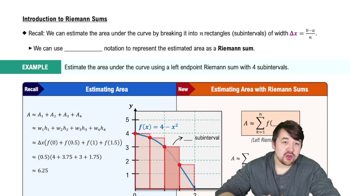
Riemann Sums

Riemann sums are a method for approximating the integral of a function, which in this case represents the displacement. By dividing the interval into n subintervals and using the left endpoint of each subinterval to determine the height of rectangles, we can estimate the area under the velocity curve. This area corresponds to the total displacement over the interval.
Recommended video:
06:11
Introduction to Riemann Sums

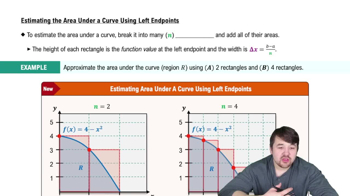
Subintervals and Left Endpoint Approximation

Subdividing the interval into n subintervals allows for a more manageable calculation of the area under the curve. The left endpoint approximation specifically uses the value of the function at the left end of each subinterval to calculate the height of the rectangles. This method provides a way to estimate the integral, which is particularly useful when the exact integral is difficult to compute.
Recommended video:
07:59
Estimating the Area Under a Curve Using Left Endpoints
Related Practice
Textbook Question

Area Find (i) the net area and (ii) the area of the following regions. Graph the function and indicate the region in question.


The region bounded by y = 6 cos 𝓍 and the 𝓍-axis between 𝓍 = ―π/2 and 𝓍 = π

Textbook Question

Approximating displacement The velocity of an object is given by the following functions on a specified interval. Approximate the displacement of the object on this interval by subdividing the interval into n subintervals. Use the left endpoint of each subinterval to compute the height of the rectangles.

v = [1 / (2t + 1)] (m/s), for 0 ≤ t ≤ 8 ; n = 4

Textbook Question

General results Evaluate the following integrals in which the function ƒ is unspecified. Note that ƒ⁽ᵖ⁾ is the pth derivative of ƒ and ƒᵖ is the pth power of ƒ. Assume ƒ and its derivatives are continuous for all real numbers. 

∫ (5 ƒ³ (𝓍) + 7ƒ² (𝓍) + ƒ (𝓍 )) ƒ'(𝓍) d𝓍

Textbook Question

{Use of Tech} Areas of regions Find the area of the region 𝑅 bounded by the graph of ƒ and the 𝓍-axis on the given interval. Graph ƒ and show the region 𝑅.                                              


 ƒ(𝓍) = 2 ― |𝓍| on [ ― 2 , 4]

Textbook Question

Average distance on a parabola What is the average distance between the parabola y = 30𝓍 (20 ― 𝓍 ) and the 𝓍-axis on the interval [0, 20] ?

Textbook Question

Suppose the interval [1, 3] is partitioned into n = 4 subintervals. What is the subinterval length ∆𝓍? List the grid points x₀ , x₁ , x₂ , x₃ and x₄. Which points are used for the left, right, and midpoint Riemann sums?

1
views