
Ch.12 - Parametric and Polar Curves
Briggs - Calculus: Early Transcendentals 3rd Edition
Briggs3rd EditionCalculus: Early TranscendentalsISBN: 9780136847243Not the one you use?Change textbook
Chapter 12, Problem 12.1.11a

11–14. Working with parametric equations Consider the following parametric equations.
a. Make a brief table of values of t, x, and y.
b. Plot the (x, y) pairs in the table and the complete parametric curve, indicating the positive orientation (the direction of increasing t).


x=2 t,y=3t−4;−10≤d≤10 

Verified step by step guidance
1
Identify the parametric equations given: \(x = 2t\) and \(y = 3t - 4\), with the parameter \(t\) ranging from \(-10\) to \(10\).
Create a table of values by choosing several values of \(t\) within the interval \([-10, 10]\). For each chosen \(t\), calculate the corresponding \(x\) and \(y\) values using the parametric equations: \(x = 2t\) and \(y = 3t - 4\).
Plot the points \((x, y)\) from the table on the Cartesian plane. Each point corresponds to a specific value of \(t\).
Draw the curve by smoothly connecting the plotted points, representing the parametric curve defined by the equations. Make sure the curve reflects the continuous change of \(t\) from \(-10\) to \(10\).
Indicate the positive orientation on the curve by adding arrows showing the direction of increasing \(t\), which corresponds to moving from points with smaller \(t\) values to larger \(t\) values.

Verified video answer for a similar problem:

This video solution was recommended by our tutors as helpful for the problem above.
Video duration:
2m
Was this helpful?

Key Concepts

Here are the essential concepts you must grasp in order to answer the question correctly.

Parametric Equations

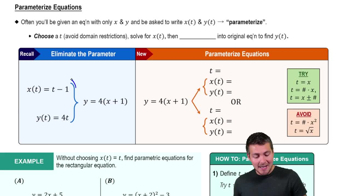
Parametric equations express the coordinates of points on a curve as functions of a parameter, usually denoted t. Instead of y as a function of x, both x and y depend on t, allowing representation of more complex curves and motions.
Recommended video:
Guided course
08:02
Parameterizing Equations

Creating a Table of Values

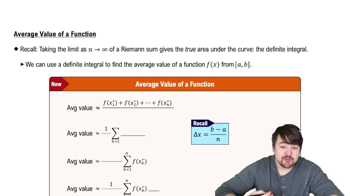
To analyze parametric equations, select values of the parameter t within the given interval, then compute corresponding x and y values. This table helps visualize points on the curve and understand how the curve evolves as t changes.
Recommended video:
06:37
Average Value of a Function

Plotting Parametric Curves and Orientation

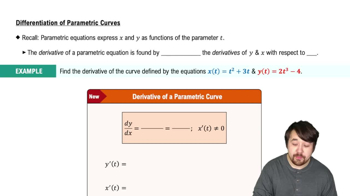
Plotting involves graphing the (x, y) pairs from the table to form the curve. The positive orientation shows the direction of increasing t, indicating how the curve is traced over time, which is important for understanding motion or directionality.
Recommended video:
06:49
Differentiation of Parametric Curves
Related Practice
Textbook Question

11–14. Working with parametric equations Consider the following parametric equations.

a. Make a brief table of values of t, x, and y.

b. Plot the (x, y) pairs in the table and the complete parametric curve, indicating the positive orientation (the direction of increasing t).


x=−t+6, y=3t−3; −5≤t≤5 

1
views
Textbook Question

The ellipse and the parabola: Let R be the region bounded by the upper half of the ellipse x²/2 + y² = 1 and the parabola y = x²/√2

a. Find the area of R

Textbook Question

Area of roses Assume m is a positive integer.


a. Even number of leaves: What is the relationship between the total area enclosed by the 4m-leaf rose r=cos(2mθ) and m?

1
views
Textbook Question

Reflection property of parabolas: Consider the parabola y = x²/(4p) with its focus at F(0, p). The goal is to show that the angle of incidence (α) equals the angle of reflection (β).

a. Let P(x₀, y₀) be a point on the parabola. Show that the slope of the tangent line at P is tan θ = x₀/(2p).

1
views
Textbook Question

Volume of a hyperbolic cap Consider the region R bounded by the right branch of the hyperbola x²/a² - y²/b² = 1 and the vertical line through the right focus.

a. What is the volume of the solid that is generated when R is revolved about the x-axis?

Textbook Question

(Use of Tech) Finger curves: r = f(θ) = cos(aᶿ) - 1.5, where a = (1 + 12π)^(1/(2π)) ≈ 1.78933

a. Show that f(0) = f(2π) and find the point on the curve that corresponds to θ = 0 and θ = 2π.

1
views