
Ch.12 - Parametric and Polar Curves
Briggs - Calculus: Early Transcendentals 3rd Edition
Briggs3rd EditionCalculus: Early TranscendentalsISBN: 9780136847243Not the one you use?Change textbook
Chapter 12, Problem 12.4.78a

The ellipse and the parabola: Let R be the region bounded by the upper half of the ellipse x²/2 + y² = 1 and the parabola y = x²/√2
a. Find the area of R

Verified step by step guidance
1
Identify the curves that bound the region R. The upper half of the ellipse is given by \(\frac{x^{2}}{2} + y^{2} = 1\), which can be rewritten to express \(y\) as \(y = \sqrt{1 - \frac{x^{2}}{2}}\). The parabola is given by \(y = \frac{x^{2}}{\sqrt{2}}\).
Find the points of intersection between the ellipse and the parabola by setting their \(y\)-values equal: \(\sqrt{1 - \frac{x^{2}}{2}} = \frac{x^{2}}{\sqrt{2}}\). Square both sides to eliminate the square root and solve for \(x\).
Determine the limits of integration from the intersection points found in step 2. These \(x\)-values will serve as the bounds for the integral representing the area of region R.
Set up the integral for the area of region R as the integral of the difference between the upper curve (ellipse) and the lower curve (parabola): \(\text{Area} = \int_{a}^{b} \left( \sqrt{1 - \frac{x^{2}}{2}} - \frac{x^{2}}{\sqrt{2}} \right) \, dx\), where \(a\) and \(b\) are the intersection points.
Evaluate the integral to find the area. This may involve substitution or numerical methods if the integral is not straightforward. Remember, the integral represents the area between the two curves over the interval \([a, b]\).

Verified video answer for a similar problem:

This video solution was recommended by our tutors as helpful for the problem above.
Video duration:
5m
Was this helpful?

Key Concepts

Here are the essential concepts you must grasp in order to answer the question correctly.

Equations of Conic Sections

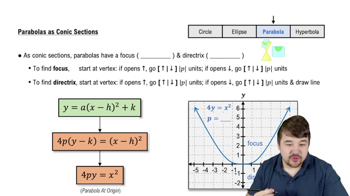
Understanding the standard forms of conic sections like ellipses and parabolas is essential. The ellipse here is given by x²/2 + y² = 1, representing a stretched circle, while the parabola y = x²/√2 is a quadratic curve. Recognizing these forms helps in setting up the problem and identifying the region bounded by these curves.
Recommended video:
5:33
Parabolas as Conic Sections

Finding Points of Intersection

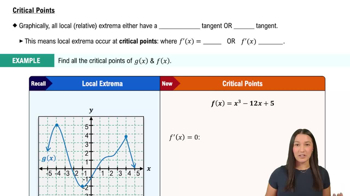
To determine the bounded region, it is crucial to find where the ellipse and parabola intersect. This involves solving the system of equations simultaneously, which provides the limits of integration for calculating the area. Accurate intersection points ensure the correct boundaries for the integral.
Recommended video:
04:50
Critical Points

Definite Integration for Area Calculation

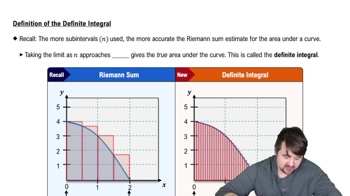
Calculating the area between curves requires setting up a definite integral with proper limits. The area of region R is found by integrating the difference between the upper curve (ellipse) and the lower curve (parabola) over the interval defined by their intersection points. This technique is fundamental in finding areas bounded by curves.
Recommended video:
05:43
Definition of the Definite Integral
Related Practice
Textbook Question

11–14. Working with parametric equations Consider the following parametric equations.

a. Make a brief table of values of t, x, and y.

b. Plot the (x, y) pairs in the table and the complete parametric curve, indicating the positive orientation (the direction of increasing t).


x=−t+6, y=3t−3; −5≤t≤5 

1
views
Textbook Question

11–14. Working with parametric equations Consider the following parametric equations.

a. Make a brief table of values of t, x, and y.

b. Plot the (x, y) pairs in the table and the complete parametric curve, indicating the positive orientation (the direction of increasing t).


x=2 t,y=3t−4;−10≤d≤10 

Textbook Question

Area of roses Assume m is a positive integer.


a. Even number of leaves: What is the relationship between the total area enclosed by the 4m-leaf rose r=cos(2mθ) and m?

1
views
Textbook Question

Reflection property of parabolas: Consider the parabola y = x²/(4p) with its focus at F(0, p). The goal is to show that the angle of incidence (α) equals the angle of reflection (β).

a. Let P(x₀, y₀) be a point on the parabola. Show that the slope of the tangent line at P is tan θ = x₀/(2p).

1
views
Textbook Question

Area of a sector of a hyperbola: Consider the region R bounded by the right branch of the hyperbola x²/a² - y²/b² = 1 and the vertical line through the right focus

a. What is the area of R?

Textbook Question

Volume of a hyperbolic cap Consider the region R bounded by the right branch of the hyperbola x²/a² - y²/b² = 1 and the vertical line through the right focus.

a. What is the volume of the solid that is generated when R is revolved about the x-axis?