
Textbook Question
In Exercises 37–42, find the series’ radius of convergence.
∑ (from n = 1 to ∞) [ (n!)² / (2ⁿ (2n)!) ] xⁿ

 Verified step by step guidance
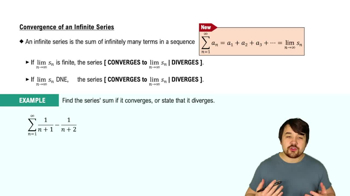
 06:52
06:52
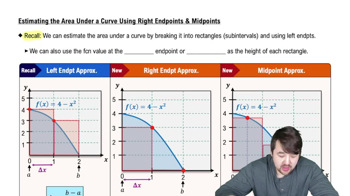 05:59
05:59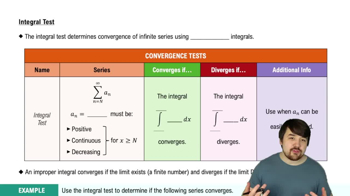 07:25
07:25In Exercises 37–42, find the series’ radius of convergence.
∑ (from n = 1 to ∞) [ (n!)² / (2ⁿ (2n)!) ] xⁿ
Finding nth Partial Sums
In Exercises 1–6, find a formula for the nth partial sum of each series and use it to find the series’ sum if the series converges.
2 + (2/3) + (2/9) + (2/27) + … + (2 / 3ⁿ⁻¹) + …
Finding a Sequence’s Formula
In Exercises 13–30, find a formula for the nth term of the sequence.
2, 6, 10, 14, 18, …Every other even positive integer
Absolute and Conditional Convergence
Which of the series in Exercises 15–48 converge absolutely, which converge, and which diverge? Give reasons for your answers.
∑ (from n = 1 to ∞) [(-1)ⁿ / (1 + √n)]
Finding Taylor Series at x = 0 (Maclaurin Series)
Find the Maclaurin series for the functions in Exercises 11–24.
5 cos πx
Determining Convergence or Divergence
Which of the series in Exercises 17–56 converge, and which diverge? Use any method, and give reasons for your answers.
∑ (from n=1 to ∞) (2ⁿ + 3ⁿ) / (3ⁿ + 4ⁿ)