Ch. 10 - Infinite Sequences and Series
Hass - Thomas' Calculus 15th Edition
Hass15th EditionThomas' CalculusISBN: 9780137616077Not the one you use?Change textbook
Chapter 10, Problem 10.2.1

Finding nth Partial Sums
In Exercises 1–6, find a formula for the nth partial sum of each series and use it to find the series’ sum if the series converges.
2 + (2/3) + (2/9) + (2/27) + … + (2 / 3ⁿ⁻¹) + …

Verified step by step guidance
1
Identify the type of series given. Notice that the series is 2 + \(\frac{2}{3}\) + \(\frac{2}{9}\) + \(\frac{2}{27}\) + \(\dots\), which is a geometric series where each term is multiplied by \(\frac{1}{3}\) to get the next term.
Write the general term of the series. The first term a is 2, and the common ratio r is \(\frac{1}{3}\). So, the nth term can be expressed as a_n = 2 \(\times\) \(\left\)(\(\frac{1}{3}\)\(\right\))^{n-1}.
Use the formula for the nth partial sum of a geometric series: S_n = a \(\times\) \(\frac{1 - r^n}{1 - r}\). Substitute a = 2 and r = \(\frac{1}{3}\) into this formula to get S_n.
Simplify the expression for S_n by plugging in the values and rewriting the formula clearly: S_n = 2 \(\times\) \(\frac{1 - \left(\frac{1}{3}\)\(\right\))^n}{1 - \(\frac{1}{3}\)}.
Determine if the series converges by examining the limit of S_n as n approaches infinity. Since |r| = \(\frac{1}{3}\) < 1, the series converges, and the sum to infinity is S = \(\frac{a}{1 - r}\).

Verified video answer for a similar problem:

This video solution was recommended by our tutors as helpful for the problem above.
Video duration:
3m
Was this helpful?

Key Concepts

Here are the essential concepts you must grasp in order to answer the question correctly.

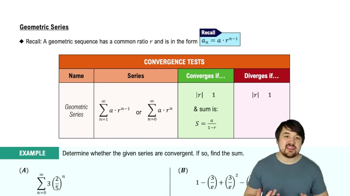
Geometric Series

A geometric series is a sum of terms where each term is found by multiplying the previous term by a constant ratio. In this problem, the series has a common ratio of 1/3, making it geometric. Understanding this helps in finding a general formula for the nth partial sum.
Recommended video:
06:00
Geometric Series

Nth Partial Sum Formula

The nth partial sum of a geometric series is given by S_n = a(1 - r^n) / (1 - r), where a is the first term and r is the common ratio. This formula allows calculation of the sum of the first n terms, which is essential for analyzing convergence and total sums.
Recommended video:
08:01
Integration Using Partial Fractions

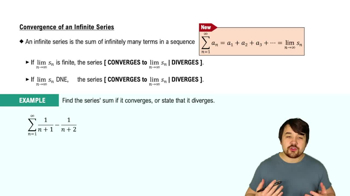
Convergence of Infinite Series

An infinite geometric series converges if the absolute value of the common ratio is less than 1. When it converges, the sum approaches S = a / (1 - r) as n approaches infinity. Recognizing convergence is key to determining the series’ total sum.
Recommended video:
06:52
Convergence of an Infinite Series