Ch. 10 - Infinite Sequences and Series
Hass - Thomas' Calculus 15th Edition
Hass15th EditionThomas' CalculusISBN: 9780137616077Not the one you use?Change textbook
Chapter 10, Problem 10.8.18

Finding Taylor Series at x = 0 (Maclaurin Series)
Find the Maclaurin series for the functions in Exercises 11–24.
5 cos πx

Verified step by step guidance
1
Recall that the Maclaurin series is the Taylor series expansion of a function at \(x = 0\), given by the formula: \[f(x) = \sum_{n=0}^{\infty} \frac{f^{(n)}(0)}{n!} x^n,\] where \(f^{(n)}(0)\) is the \(n\)-th derivative of \(f\) evaluated at 0.
Identify the base function inside the given function. Here, the function is \(f(x) = 5 \cos(\pi x)\). We can factor out the constant 5 and focus on the Maclaurin series for \(\cos(\pi x)\).
Recall the Maclaurin series for \(\cos u\) is \[\cos u = \sum_{n=0}^{\infty} (-1)^n \frac{u^{2n}}{(2n)!}.\] In this problem, substitute \(u = \pi x\) to get \[\cos(\pi x) = \sum_{n=0}^{\infty} (-1)^n \frac{(\pi x)^{2n}}{(2n)!}.\]
Multiply the entire series by 5 to account for the coefficient in the original function: \[5 \cos(\pi x) = 5 \sum_{n=0}^{\infty} (-1)^n \frac{(\pi x)^{2n}}{(2n)!} = \sum_{n=0}^{\infty} 5 (-1)^n \frac{\pi^{2n} x^{2n}}{(2n)!}.\]
Write out the first few terms explicitly by plugging in \(n=0,1,2,\ldots\) to see the pattern of the series, which helps in understanding the expansion and verifying correctness.

Verified video answer for a similar problem:

This video solution was recommended by our tutors as helpful for the problem above.
Video duration:
1m
Was this helpful?

Key Concepts

Here are the essential concepts you must grasp in order to answer the question correctly.

Maclaurin Series

A Maclaurin series is a special case of the Taylor series expanded at x = 0. It represents a function as an infinite sum of its derivatives evaluated at zero, multiplied by powers of x and divided by factorial terms. This series helps approximate functions near zero.
Recommended video:
08:26
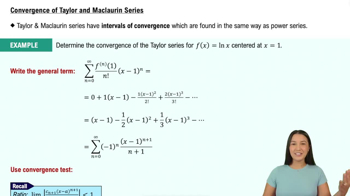
Convergence of Taylor & Maclaurin Series

Derivatives of Trigonometric Functions

To find the Maclaurin series of 5 cos(πx), you need to compute derivatives of cos(πx) at x = 0. The derivatives cycle every four steps due to the periodic nature of cosine and sine, and each derivative involves the chain rule because of the inner function πx.
Recommended video:
06:35
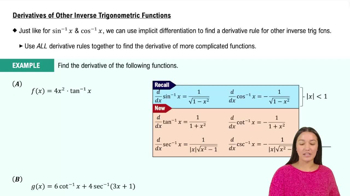
Derivatives of Other Inverse Trigonometric Functions

Chain Rule in Differentiation

The chain rule is used to differentiate composite functions like cos(πx). It states that the derivative of f(g(x)) is f'(g(x)) times g'(x). Applying this rule correctly is essential to find the derivatives needed for the Maclaurin series coefficients.
Recommended video:
05:02
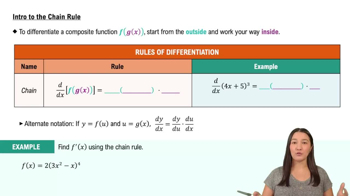
Intro to the Chain Rule