Back
BackFoundations of Human Biology: Structure, Chemistry, and Cells
Study Guide - Smart Notes
 Tailored notes based on your materials, expanded with key definitions, examples, and context.
Chapter 1: The Human Body – An Orientation
1.1 Anatomy and Physiology: Definitions and Relationship
Anatomy is the study of the structure of body parts and their relationships, while physiology is the study of the function of those parts. The two are closely related, as structure determines function (the principle of complementarity).
Gross (macroscopic) anatomy: Study of large structures visible to the naked eye (regional, systemic, surface anatomy).
Microscopic anatomy: Study of structures too small to be seen unaided (cytology, histology).
Developmental anatomy: Study of structural changes throughout the lifespan (embryology focuses on development before birth).
Specialized branches: Pathological, radiographic anatomy, etc.
Physiology: Subdivided by organ systems; focuses on cellular/molecular events and applies principles of physics and chemistry.
Example: The structure of the heart (thick muscular walls) enables its function (pumping blood).
1.2 Levels of Structural Organization and Organ Systems
The human body is organized hierarchically:
Chemical level: Atoms → molecules → organelles
Cellular level: Cells (basic unit of life)
Tissue level: Groups of similar cells with a common function
Organ level: Discrete structures with specific functions
Organ system level: Groups of organs working together
Organismal level: The complete living being
There are 11 major organ systems (e.g., integumentary, skeletal, muscular, nervous, endocrine, cardiovascular, lymphatic/immune, respiratory, digestive, urinary, reproductive), each with distinct functions.
1.3 Requirements for Life and Survival Needs
To maintain life, humans must perform certain functions and meet survival needs:
Necessary life functions: Maintaining boundaries, movement, responsiveness, digestion, metabolism, excretion, reproduction, growth
Survival needs: Nutrients, oxygen, water, normal body temperature, appropriate atmospheric pressure
1.4 Homeostasis and Feedback Mechanisms
Homeostasis is the maintenance of a stable internal environment. It is regulated by feedback systems:
Negative feedback: Reduces the effect of the original stimulus (e.g., body temperature regulation)
Positive feedback: Enhances the original stimulus (e.g., blood clotting)
Feedforward responses: Anticipate changes and adjust before they occur
Imbalances in homeostasis can lead to disease.
1.5 Anatomical Terms, Directions, and Planes
Standardized anatomical terms describe body positions, directions, regions, and planes:
Anatomical position: Body erect, palms forward, thumbs outward
Directional terms: Superior/inferior, anterior/posterior, medial/lateral, proximal/distal, superficial/deep
Body planes: Sagittal (left/right), frontal (anterior/posterior), transverse (superior/inferior), oblique
1.6 Body Cavities and Membranes
The body contains internal cavities (dorsal and ventral) lined by membranes, housing organs and providing protection:
Dorsal cavity: Cranial and vertebral cavities
Ventral cavity: Thoracic (pleural, pericardial, mediastinum) and abdominopelvic (abdominal, pelvic) cavities
Serous membranes: Parietal (lines cavity walls) and visceral (covers organs), separated by serous fluid
Abdominopelvic regions/quadrants: Used for clinical reference
Chapter 2: Chemistry Comes Alive
2.1 Matter and Energy
Matter is anything with mass and volume; energy is the capacity to do work (kinetic = movement, potential = stored). Major forms: chemical, electrical, mechanical, radiant.
2.2 Elements and Atomic Structure
Elements: Unique substances (C, H, O, N = 96% of body mass)
Atoms: Protons (+), neutrons (0), electrons (–)
Atomic number: Number of protons
Isotopes: Same protons, different neutrons; radioisotopes are unstable
2.3 Molecules, Compounds, and Mixtures
Molecule: Two or more atoms bonded
Compound: Two or more different atoms bonded
Mixtures: Physical combinations (solutions, colloids, suspensions)
2.4 Chemical Bonds
Ionic bonds: Transfer of electrons (cations/anions)
Covalent bonds: Sharing of electrons (polar/nonpolar)
Hydrogen bonds: Weak attractions, important in water/protein structure
2.5 Chemical Reactions
Synthesis (anabolic): A + B → AB
Decomposition (catabolic): AB → A + B
Exchange: AB + C → AC + B
Oxidation-reduction: Electron transfer (basis for ATP production)
Factors affecting rate: Temperature, concentration, particle size, catalysts
2.6 Inorganic Compounds: Water, Salts, Acids, and Bases
Water: High heat capacity, solvent, reactivity, cushioning
Salts: Ionic compounds, electrolytes
Acids/bases: Release H+ (acids) or OH– (bases); pH scale (0–14)
Buffers: Resist pH changes
2.7 Organic Compounds: Synthesis and Breakdown
Dehydration synthesis: Joins monomers, releases water
Hydrolysis: Breaks polymers, uses water
2.8 Carbohydrates
Monosaccharides: Simple sugars (glucose)
Disaccharides: Two monosaccharides (sucrose)
Polysaccharides: Long chains (starch, glycogen)
Function: Energy source
2.9 Lipids
Triglycerides: Energy storage, insulation
Phospholipids: Membrane structure
Steroids: Hormones, membrane components
2.10 Proteins
Structure: Amino acids, peptide bonds, four levels (primary, secondary, tertiary, quaternary)
Fibrous vs. globular: Structural vs. functional roles
Enzymes: Biological catalysts, lower activation energy
2.11 Nucleic Acids: DNA and RNA
DNA: Double helix, genetic material, A-T, G-C base pairing
RNA: Single strand, protein synthesis, A-U, G-C base pairing
2.12 ATP: The Energy Currency
ATP: Adenosine triphosphate, stores and transfers energy via phosphorylation
Cellular work: Transport, mechanical, chemical
Chapter 3: Cells – The Living Units
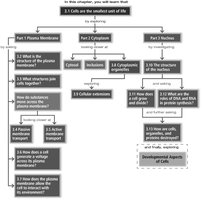
3.1 Cell Theory and Generalized Cell Structure
Cells are the basic unit of life. All organisms are made of cells, and all cells arise from pre-existing cells. A typical cell has:
Plasma membrane: Selective barrier
Cytoplasm: Fluid with organelles
Nucleus: Control center
Extracellular materials include fluids, secretions, and the extracellular matrix.
3.2 Plasma Membrane Structure
The plasma membrane is a phospholipid bilayer with embedded proteins (fluid mosaic model). Key components:
Phospholipids: Hydrophilic heads, hydrophobic tails
Cholesterol: Stabilizes membrane
Proteins: Integral (transport, channels), peripheral (enzymes, support)
Glycocalyx: Carbohydrate-rich area for cell recognition
3.3 Intercellular Junctions
Tight junctions: Impermeable, prevent leakage
Desmosomes: Anchoring, resist tearing
Gap junctions: Communication, allow ions/molecules to pass
3.4 Passive Membrane Transport
Simple diffusion: Nonpolar molecules move through bilayer
Facilitated diffusion: Uses carrier/channel proteins for polar molecules
Osmosis: Water movement across membrane
Tonicity: Isotonic, hypertonic, hypotonic solutions affect cell volume
3.5 Active Membrane Transport
Primary active transport: Direct use of ATP (e.g., Na+/K+ pump)
Secondary active transport: Indirect use of ATP via ion gradients
Vesicular transport: Endocytosis (phagocytosis, pinocytosis, receptor-mediated), exocytosis
3.6 Membrane Potential
Selective ion diffusion creates a voltage (resting membrane potential) across the membrane, mainly due to K+ gradients. Active transport maintains this potential.
3.7 Cell Adhesion Molecules and Membrane Receptors
CAMs: Attach cells, guide movement, signal immune cells
Membrane receptors: Contact and chemical signaling (e.g., G protein-coupled receptors)
3.8 Cytoplasmic Organelles
Mitochondria: ATP production
Ribosomes: Protein synthesis
Endoplasmic reticulum: Rough (protein synthesis), smooth (lipid metabolism, detox)
Golgi apparatus: Modifies, packages proteins/lipids
Lysosomes: Digestive enzymes
Peroxisomes: Detoxification
Cytoskeleton: Structural support, movement (microfilaments, intermediate filaments, microtubules)
Centrosome/centrioles: Organize microtubules, cell division
3.9 Cellular Extensions
Cilia: Motile, move substances
Flagella: Motility (e.g., sperm)
Microvilli: Increase surface area
3.10 The Nucleus
Nuclear envelope: Double membrane with pores
Nucleoli: Ribosome assembly
Chromatin: DNA + proteins; condenses to chromosomes during division
3.11 The Cell Cycle
Interphase: G1 (growth), S (DNA synthesis), G2 (prep for division)
Mitosis: Prophase, metaphase, anaphase, telophase
Cytokinesis: Division of cytoplasm
3.12 Protein Synthesis
Gene: DNA segment coding for a polypeptide
Transcription: DNA → mRNA
Translation: mRNA → protein (involves tRNA, rRNA)
Codons: mRNA triplets; anticodons: tRNA triplets
3.13 Cell Destruction and Aging
Autophagy: Digestion of cell parts
Ubiquitin-proteasome pathway: Protein degradation
Apoptosis: Programmed cell death
Cell aging: Theories include wear-and-tear, mitochondrial, immune, and genetic (telomere shortening)
Developmental Aspects of Cells
Cell differentiation: Specialization during development
Hyperplasia: Increased cell number
Atrophy: Decreased cell/tissue size