Ch. 5 The Integumentary System
Martini - Fundamentals of Anatomy and Physiology 12th Edition
Martini, Nath, Bartholomew12th EditionFundamentals of Anatomy and PhysiologyISBN: 9780137854011Not the one you use?Change textbook
Chapter 5, Problem 1c

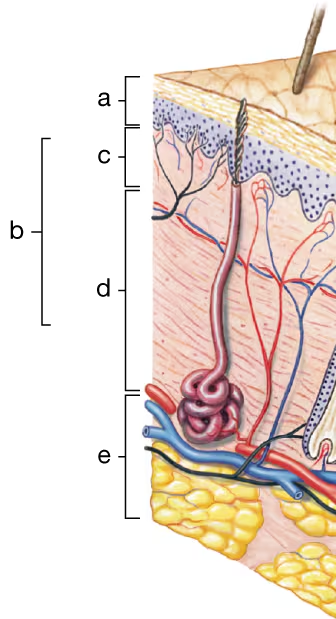
Identify the different portions (a–d) of the cutaneous membrane and the underlying layer of loose connective tissue (e) in the diagram to the right.
c. ____

Verified step by step guidance
1
Step 1: Understand the layers of the cutaneous membrane. The cutaneous membrane consists of the epidermis (a), dermis (b and c), and the underlying layer of loose connective tissue (e) called the hypodermis or subcutaneous layer.
Step 2: Identify the labeled portions in the diagram. Portion 'a' corresponds to the epidermis, which is the outermost layer composed mainly of stratified squamous epithelium.
Step 3: Portion 'b' is the papillary layer of the dermis, which is the upper part of the dermis containing loose connective tissue and capillaries.
Step 4: Portion 'c' is the reticular layer of the dermis, which is the deeper, thicker part of the dermis composed of dense irregular connective tissue.
Step 5: Portion 'e' is the hypodermis or subcutaneous layer, which lies beneath the dermis and consists mainly of loose connective tissue and adipose tissue.

Verified video answer for a similar problem:

This video solution was recommended by our tutors as helpful for the problem above.
Video duration:
1m
Was this helpful?

Key Concepts

Here are the essential concepts you must grasp in order to answer the question correctly.

Epidermis

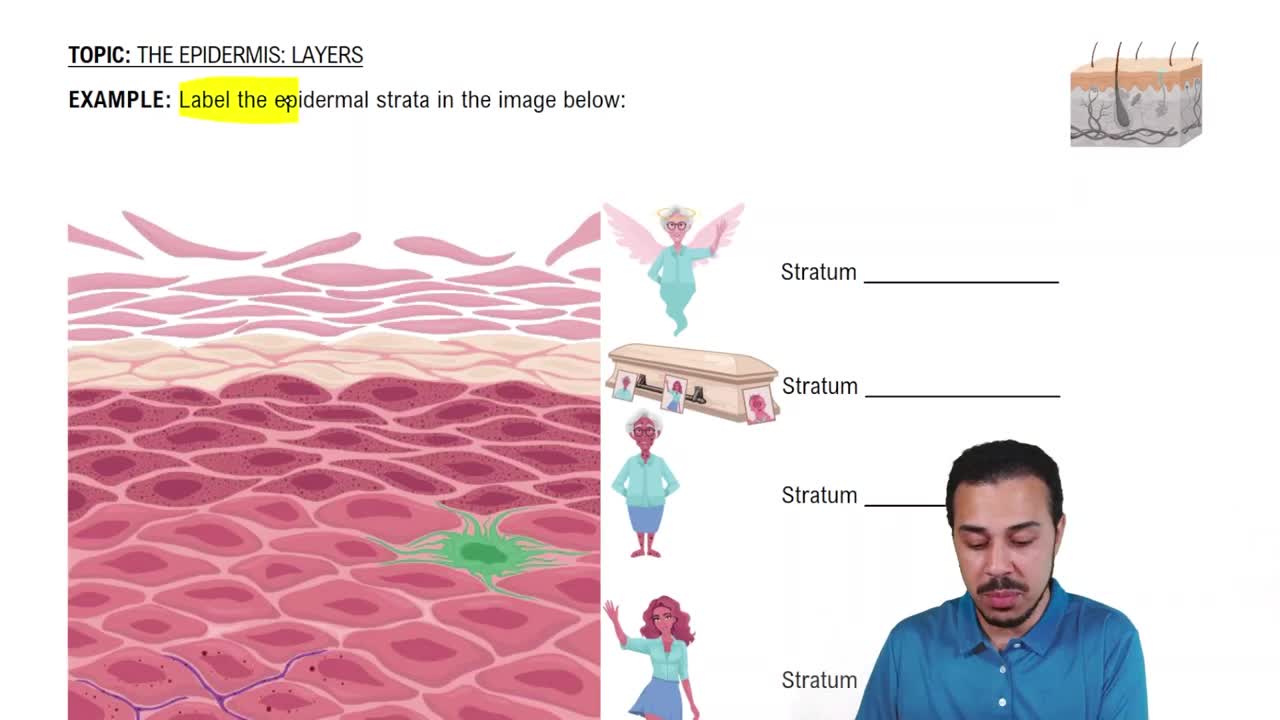
The epidermis is the outermost layer of the skin, composed mainly of keratinized stratified squamous epithelium. It serves as a protective barrier against environmental damage, pathogens, and water loss. This layer is avascular and relies on diffusion from underlying layers for nutrients.
Recommended video:
04:09
The Epidermis: Layers Example 2

Dermis

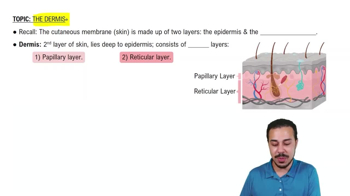
The dermis lies beneath the epidermis and is a thick layer of connective tissue containing collagen and elastin fibers. It houses blood vessels, nerves, hair follicles, and glands, providing structural support and nourishment to the epidermis. The dermis is divided into the papillary and reticular layers.
Recommended video:
01:20
Introduction to the Dermis

Hypodermis (Subcutaneous Layer)

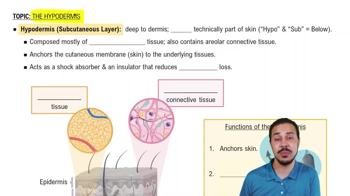
The hypodermis, or subcutaneous layer, is composed mainly of loose connective tissue and adipose tissue. It acts as an insulator, shock absorber, and energy reserve, anchoring the skin to underlying muscles and bones. This layer contains larger blood vessels and nerves that supply the skin.
Recommended video:
02:44
The Hypodermis