Ch. 5 The Integumentary System
Martini - Fundamentals of Anatomy and Physiology 12th Edition
Martini, Nath, Bartholomew12th EditionFundamentals of Anatomy and PhysiologyISBN: 9780137854011Not the one you use?Change textbook
Chapter 5, Problem 1e

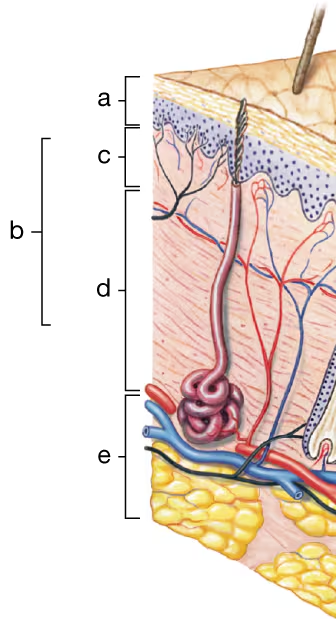
Identify the different portions (a–d) of the cutaneous membrane and the underlying layer of loose connective tissue (e) in the diagram to the right.
e. ____
Diagram of skin layers, highlighting cutaneous membrane sections and loose connective tissue beneath.

Verified step by step guidance
1
Step 1: Understand the layers of the cutaneous membrane. The cutaneous membrane consists of two main layers: the epidermis (outer layer) and the dermis (inner layer). The dermis itself is divided into two portions: the papillary layer and the reticular layer.
Step 2: Identify portions a–d in the diagram. Portion 'a' corresponds to the epidermis, which is the outermost layer composed mainly of stratified squamous epithelial cells.
Step 3: Portion 'b' is the papillary layer of the dermis, which lies just beneath the epidermis and contains loose connective tissue with capillaries and sensory neurons.
Step 4: Portion 'c' is the reticular layer of the dermis, which is deeper and composed of dense irregular connective tissue, providing strength and elasticity to the skin.
Step 5: Portion 'e' is the underlying layer beneath the dermis, which is the hypodermis (also called the subcutaneous layer). This layer consists mainly of loose connective tissue and adipose tissue, providing insulation and cushioning.

Verified video answer for a similar problem:

This video solution was recommended by our tutors as helpful for the problem above.
Video duration:
2m
Was this helpful?

Key Concepts

Here are the essential concepts you must grasp in order to answer the question correctly.

Cutaneous Membrane Layers

The cutaneous membrane consists of two main layers: the epidermis (a) and the dermis (b and c). The epidermis is the outermost layer providing protection, while the dermis beneath contains connective tissue, blood vessels, and nerves, supporting skin functions.
Recommended video:
02:31
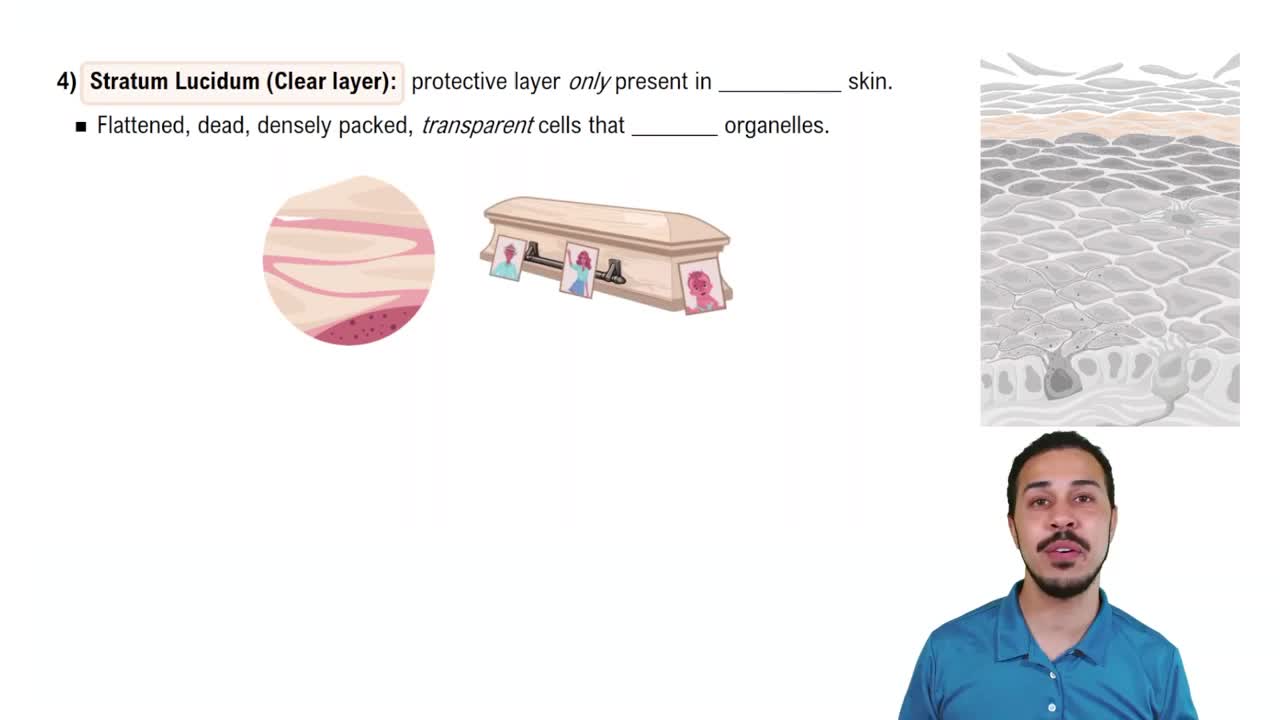
Epidermal Layers: Stratum Lucidum (Clear Layer)

Dermis Subdivisions: Papillary and Reticular Layers

The dermis is divided into the papillary layer (b), which is the upper, loose connective tissue layer with capillaries and sensory neurons, and the reticular layer (c), a deeper, dense connective tissue layer providing strength and elasticity to the skin.
Recommended video:
06:14
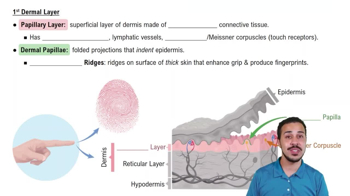
1st Dermal Layer

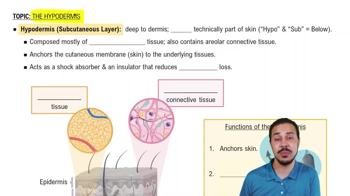
Hypodermis (Subcutaneous Layer)

The hypodermis (e) lies beneath the dermis and consists mainly of loose connective tissue and adipose tissue. It anchors the skin to underlying structures, provides insulation, and cushions the body.
Recommended video:
02:44
The Hypodermis