Ch. 4 The Tissue Level of Organization
Martini - Fundamentals of Anatomy and Physiology 12th Edition
Martini, Nath, Bartholomew12th EditionFundamentals of Anatomy and PhysiologyISBN: 9780137854011Not the one you use?Change textbook
Chapter 4, Problem 5

The most abundant connections between cells in the superficial layers of the skin are
(a) Connexons
(b) Gap junctions
(c) Desmosomes
(d) Tight junctions

Verified step by step guidance
1
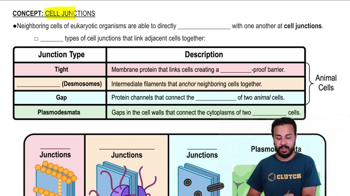
Step 1: Understand the types of cell junctions mentioned in the options. Connexons are protein complexes that form gap junctions, which allow communication between cells by permitting the passage of ions and small molecules.
Step 2: Recognize that gap junctions (option b) are specialized for cell-to-cell communication but are not the most abundant in the superficial layers of the skin.
Step 3: Tight junctions (option d) create a seal between cells to prevent leakage of extracellular fluid, commonly found in epithelial tissues but not the most abundant in the skin's superficial layers.
Step 4: Desmosomes (option c) are strong adhesive junctions that connect the cytoskeletons of adjacent cells, providing mechanical strength and resistance to stress, especially important in the skin's outer layers.
Step 5: Conclude that the most abundant connections between cells in the superficial layers of the skin are desmosomes, as they maintain the structural integrity of the skin under mechanical stress.

Verified video answer for a similar problem:

This video solution was recommended by our tutors as helpful for the problem above.
Video duration:
1m
Was this helpful?

Key Concepts

Here are the essential concepts you must grasp in order to answer the question correctly.

Desmosomes

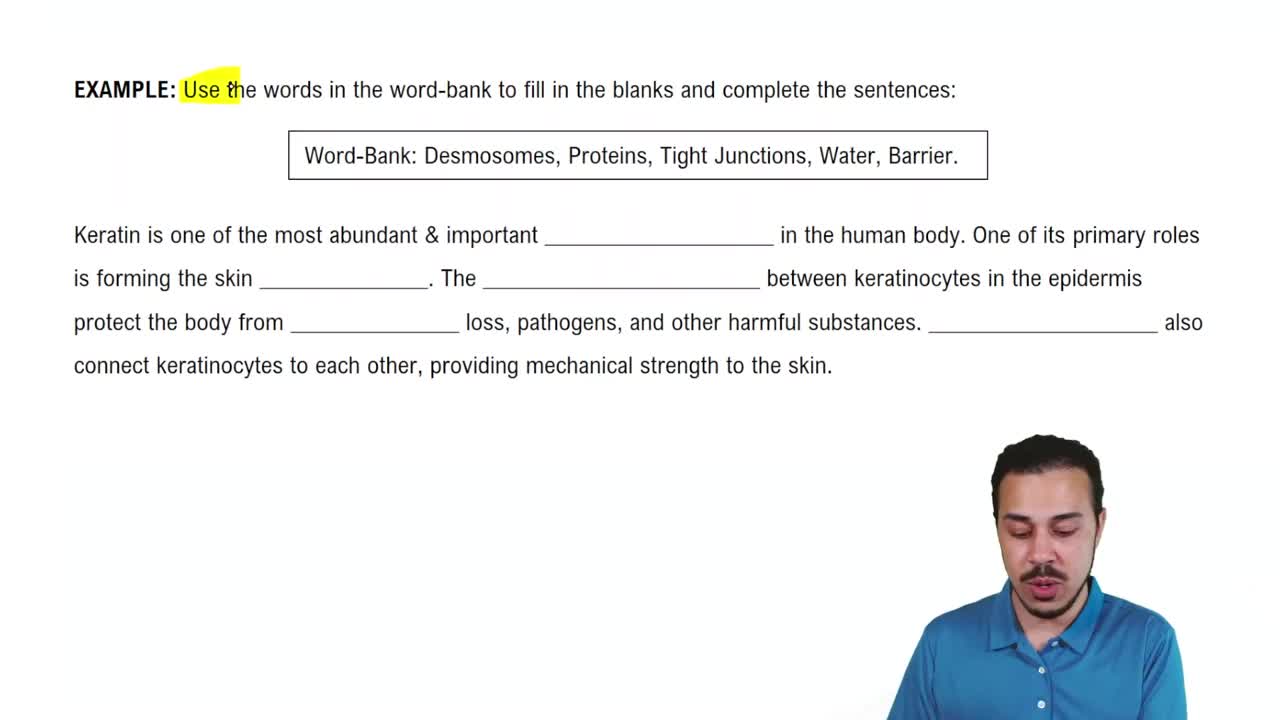
Desmosomes are strong, adhesive cell structures that connect adjacent cells, especially in tissues subject to mechanical stress like the skin. They provide structural integrity by linking the cytoskeletons of neighboring cells, making them abundant in the superficial layers of the skin.
Recommended video:
03:17
The Epidermis: Cells Example 1

Gap Junctions

Gap junctions are specialized intercellular connections that allow direct communication between cells through channels called connexons. They enable the transfer of ions and small molecules but are less abundant in the skin's superficial layers compared to desmosomes.
Recommended video:
05:33
Cell Junctions

Tight Junctions

Tight junctions create a seal between adjacent cells to prevent the passage of molecules and ions through the space between cells. While important for barrier function, they are not the most abundant connections in the superficial skin layers.
Recommended video:
05:33
Cell Junctions