Ch. 4 The Tissue Level of Organization
Martini - Fundamentals of Anatomy and Physiology 12th Edition
Martini, Nath, Bartholomew12th EditionFundamentals of Anatomy and PhysiologyISBN: 9780137854011Not the one you use?Change textbook
Chapter 4, Problem 2

Collections of specialized cells and cell products that perform a relatively limited number of functions are called
(a) Cellular aggregates,
(b) Tissues
(c) Organs
(d) Organ systems
(e) Organisms

Verified step by step guidance
1
Understand the definitions of each term provided in the options to identify which best fits the description of 'collections of specialized cells and cell products that perform a relatively limited number of functions.'
Recall that 'cellular aggregates' generally refer to groups of cells but do not specify function or specialization clearly.
Recognize that 'tissues' are groups of similar cells and their products that work together to perform a specific function or a limited set of functions.
Note that 'organs' are structures composed of multiple tissue types working together to perform complex functions, which is broader than the description given.
Understand that 'organ systems' and 'organisms' represent higher levels of biological organization involving multiple organs or the entire living being, respectively, which exceed the scope of the question.

Verified video answer for a similar problem:

This video solution was recommended by our tutors as helpful for the problem above.
Video duration:
2m
Was this helpful?

Key Concepts

Here are the essential concepts you must grasp in order to answer the question correctly.

Cells and Cell Specialization

Cells are the basic units of life, and specialization refers to cells developing specific structures and functions. Specialized cells work together to perform particular tasks, forming the foundation for higher levels of biological organization.
Recommended video:
05:33
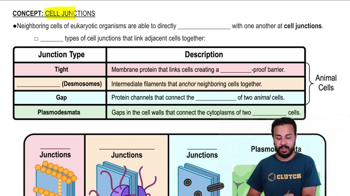
Cell Junctions

Tissues

Tissues are groups of similar specialized cells and their products that work together to perform a limited set of functions. They represent the first level of organization beyond individual cells, such as muscle tissue or nervous tissue.
Recommended video:
4:55
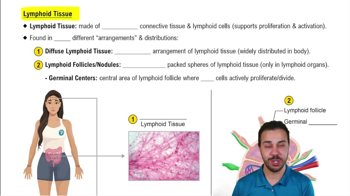
Lymphoid Tissue

Biological Organization Levels

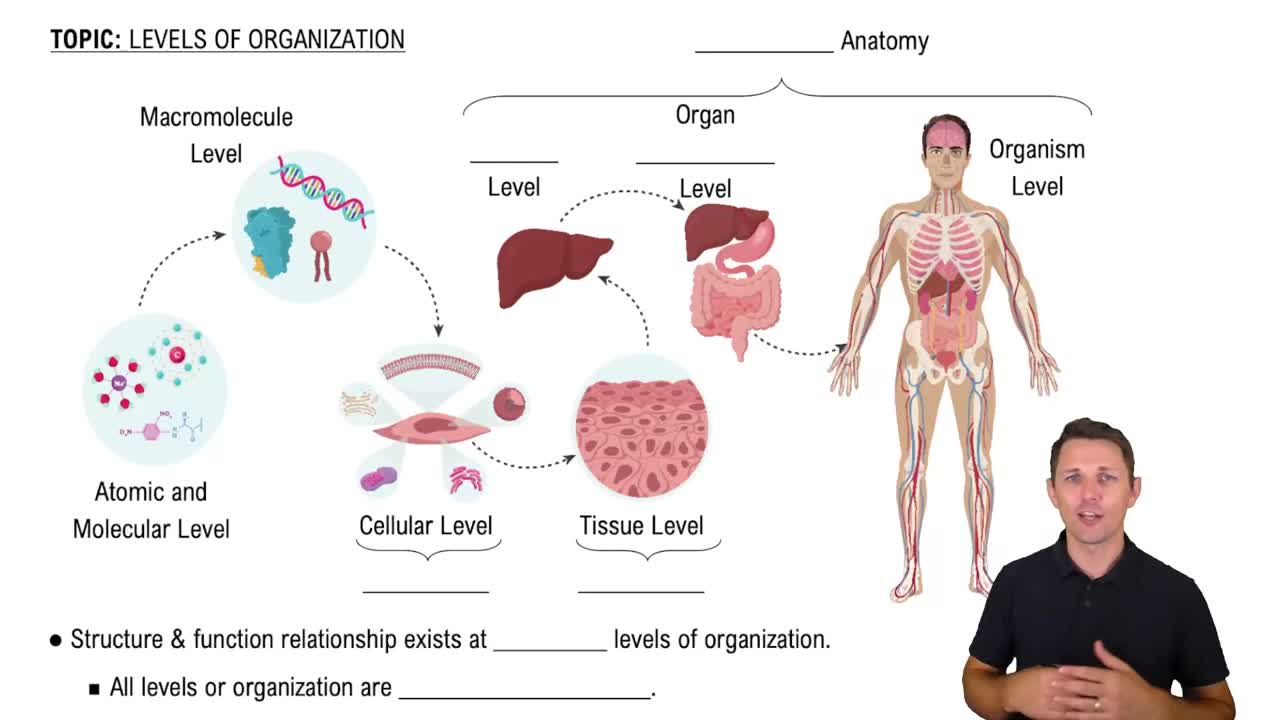
Biological organization progresses from cells to tissues, organs, organ systems, and organisms. Each level represents increasing complexity and integration, with tissues forming organs, organs forming systems, and systems forming whole organisms.
Recommended video:
Guided course
05:04
The Levels of Organization