Textbook Question
The most abundant connections between cells in the superficial layers of the skin are
(a) Connexons
(b) Gap junctions
(c) Desmosomes
(d) Tight junctions
1
views

 Martini, Nath, Bartholomew 12th EditionCh. 4 The Tissue Level of OrganizationProblem 10
 Verified step by step guidance
 08:24
08:24
 03:25
03:25 02:59
02:59The most abundant connections between cells in the superficial layers of the skin are
(a) Connexons
(b) Gap junctions
(c) Desmosomes
(d) Tight junctions
Axons, dendrites, and a cell body are characteristic of cells located in
(a) Nervous tissue
(b) Muscle tissue
(c) Connective tissue
(d) Epithelial tissue
The type of cartilage growth characterized by adding new layers of cartilage to the surface is
(a) Interstitial growth
(b) Appositional growth
(c) Intramembranous growth
(d) Longitudinal growth.
Which of the following epithelia most easily permits diffusion?
(a) Stratified squamous
(b) Simple squamous
(c) Transitional
(d) Simple columnar
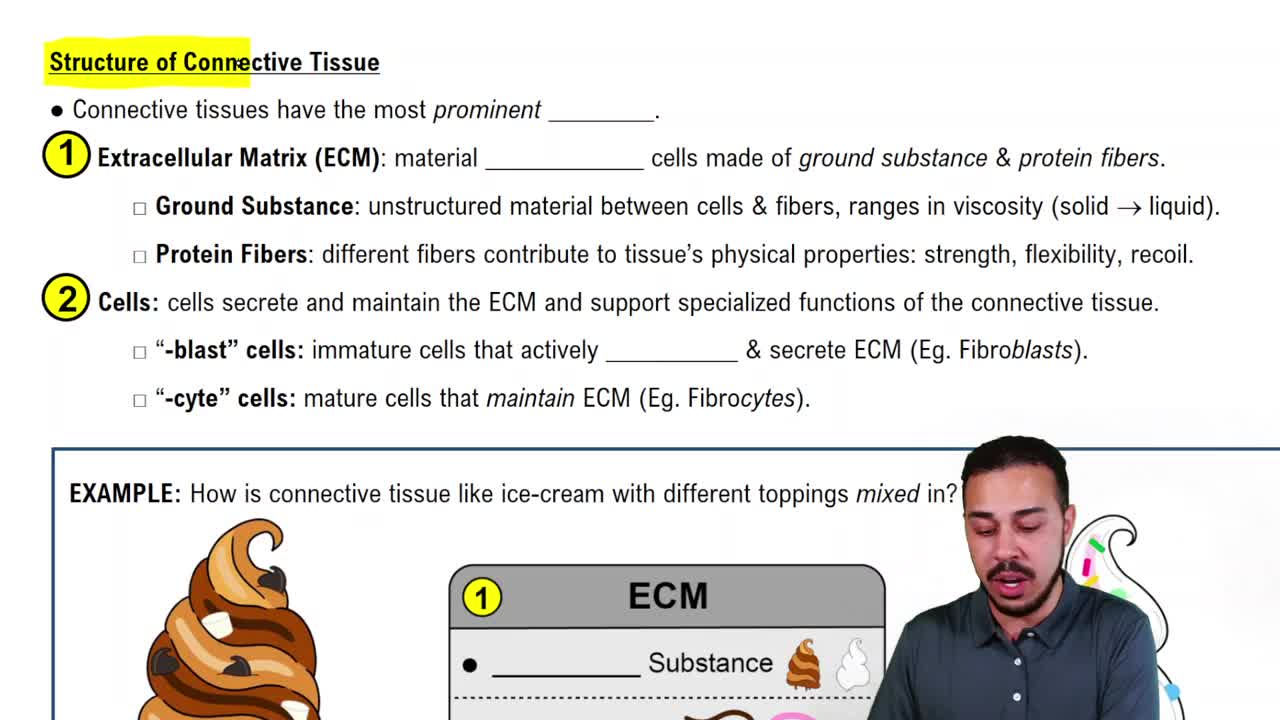
Matrix is a characteristic of which type of tissue?
(a) Epithelial
(b) Nervous
(c) Muscle
(d) Connective
The three major types of cartilage in the body are
(a) Collagen, reticular, and elastic
(b) Areolar, adipose, and reticular
(c) Hyaline, elastic, and fibrous
(d) Tendons, reticular, and elastic