Ch. 26 The Urinary System
Martini - Fundamentals of Anatomy and Physiology 12th Edition
Martini, Nath, Bartholomew12th EditionFundamentals of Anatomy and PhysiologyISBN: 9780137854011Not the one you use?Change textbook
Chapter 25, Problem 16

When the renal threshold for a substance exceeds its tubular maximum:
(a) More of the substance will be filtered
(b) More of the substance will be reabsorbed
(c) More of the substance will be secreted
(d) The amount of the substance that exceeds the tubular maximum will be found in the urine
(e) Both a and d occur

Verified step by step guidance
1
Step 1: Understand the key terms involved in the problem. The 'renal threshold' is the plasma concentration level at which a substance begins to appear in the urine because the kidneys cannot reabsorb it all. The 'tubular maximum' (Tm) is the maximum rate at which the renal tubules can reabsorb a substance.
Step 2: Recognize that when the plasma concentration of a substance exceeds the renal threshold, the filtered load of that substance surpasses the tubular maximum reabsorption capacity.
Step 3: Since the tubular maximum is exceeded, the tubules cannot reabsorb all of the filtered substance, so the excess amount remains in the tubular fluid and is excreted in the urine.
Step 4: Analyze the answer choices in this context: (a) More of the substance will be filtered — filtration depends on plasma concentration and glomerular filtration rate, so if plasma concentration increases, filtered load increases; (d) The amount exceeding the tubular maximum will appear in urine because it cannot be reabsorbed.
Step 5: Conclude that the correct understanding is that both more of the substance is filtered (due to higher plasma concentration) and the excess beyond the tubular maximum appears in urine, which corresponds to answer (e).

Verified video answer for a similar problem:

This video solution was recommended by our tutors as helpful for the problem above.
Was this helpful?

Key Concepts

Here are the essential concepts you must grasp in order to answer the question correctly.

Renal Threshold

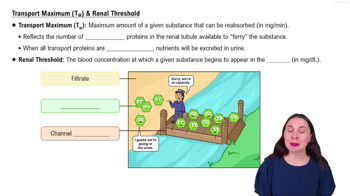
The renal threshold is the plasma concentration level of a substance at which the kidneys begin to excrete it into the urine because reabsorption mechanisms are saturated. Below this threshold, the substance is mostly reabsorbed; above it, excess amounts appear in urine.
Recommended video:
4:35
Transport Maximum (TM) & Renal Threshold

Tubular Maximum (Tm)

Tubular maximum refers to the highest rate at which a substance can be reabsorbed or secreted by the renal tubules. When the filtered load exceeds this maximum, the excess substance cannot be reabsorbed and is excreted in urine.
Recommended video:
4:35
Transport Maximum (TM) & Renal Threshold

Relationship Between Renal Threshold and Tubular Maximum

If the renal threshold exceeds the tubular maximum, it means the plasma concentration is high enough that the filtered load surpasses the reabsorption capacity. Consequently, the surplus substance appears in urine, indicating saturation of reabsorption.
Recommended video:
4:35
Transport Maximum (TM) & Renal Threshold