
Textbook Question
Sylvia is suffering from severe edema in her arms and legs. Her physician prescribes a diuretic (a substance that increases the volume of urine produced). Why might this help alleviate Sylvia’s problem?
1
views

 Verified step by step guidance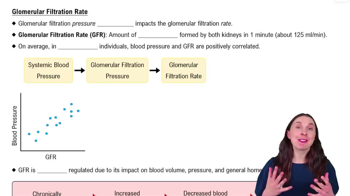
 3:15
3:15
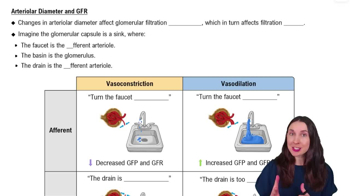 4:33
4:33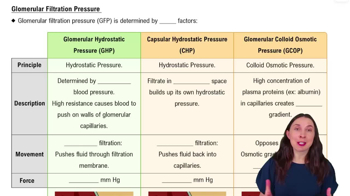 3:49
3:49Sylvia is suffering from severe edema in her arms and legs. Her physician prescribes a diuretic (a substance that increases the volume of urine produced). Why might this help alleviate Sylvia’s problem?
Describe the urine voiding reflex.
What primary changes occur in the composition and concentration of filtrate as a result of activity in the proximal convoluted tubule?
David’s grandfather suffers from hypertension. His doctor tells him that part of his problem stems from renal arteriosclerosis. Why would this cause hypertension?
In response to excess water in the body,
(a) Antidiuretic hormone is secreted by the anterior lobe of the pituitary gland.
(b) The active transport mechanisms in the ascending thick limb of the nephron loop cease functioning.
(c) The permeability of the distal convoluted tubules and collecting ducts to water is decreased.
(d) The permeability of the ascending limb of the nephron loop is increased.
(e) The glomerular filtration rate is reduced.
Describe two functions of countercurrent multiplication in the kidney.