Ch. 24 The Digestive System
Martini - Fundamentals of Anatomy and Physiology 12th Edition
Martini, Nath, Bartholomew12th EditionFundamentals of Anatomy and PhysiologyISBN: 9780137854011Not the one you use?Change textbook
Chapter 24, Problem 8

Regional movements that occur in the small intestine and function to churn and fragment the digestive material are called:
(a) Segmentation
(b) Pendular movements
(c) Peristalsis
(d) Mass movements
(e) Mastication

Verified step by step guidance
1
Step 1: Understand the types of movements in the digestive system. The small intestine exhibits several types of movements that help in digestion and absorption.
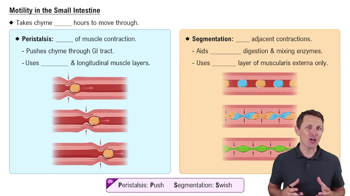
Step 2: Define each option: (a) Segmentation involves rhythmic contractions that churn and mix the intestinal contents, breaking them into smaller pieces without moving them forward significantly.
(b) Pendular movements are longitudinal muscle contractions that help move contents back and forth but are less involved in fragmentation.
(c) Peristalsis is a wave-like contraction that propels contents forward through the digestive tract.
(d) Mass movements are strong peristaltic waves in the large intestine that move fecal material toward the rectum.
(e) Mastication is the process of chewing in the mouth, not related to intestinal movements.
Step 3: Identify which movement specifically churns and fragments digestive material in the small intestine. This is the key to selecting the correct answer.

Verified video answer for a similar problem:

This video solution was recommended by our tutors as helpful for the problem above.
Was this helpful?

Key Concepts

Here are the essential concepts you must grasp in order to answer the question correctly.

Segmentation

Segmentation refers to localized contractions in the small intestine that mix and churn the digestive contents. These movements help fragment food and enhance contact with digestive enzymes and absorptive surfaces, facilitating nutrient absorption.
Recommended video:
7:52
Antibody Class Switching

Peristalsis

Peristalsis is a series of wave-like muscle contractions that move food along the digestive tract. Unlike segmentation, peristalsis primarily propels contents forward rather than mixing or fragmenting them.
Recommended video:
Guided course
3:06
Motility in the Small Intestine

Pendular Movements

Pendular movements are longitudinal muscle contractions in the small intestine that create a back-and-forth motion. This action helps mix intestinal contents but is less involved in fragmenting food compared to segmentation.
Recommended video:
08:43
Functional Joint Classifications