Ch. 24 The Digestive System
Martini - Fundamentals of Anatomy and Physiology 12th Edition
Martini, Nath, Bartholomew12th EditionFundamentals of Anatomy and PhysiologyISBN: 9780137854011Not the one you use?Change textbook
Chapter 24, Problem 10

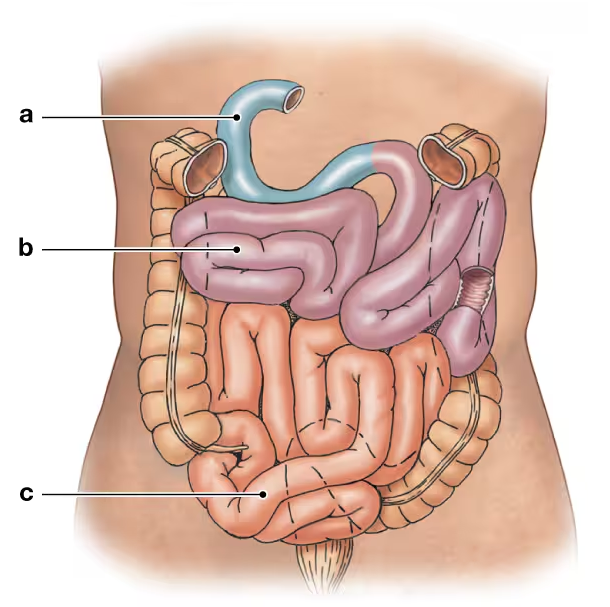
Label the three segments of the small intestine in the following figure.
Diagram of the small intestine with three labeled segments marked a, b, and c for identification.
a. ___
b. ___
c. ___

Verified step by step guidance
1
Step 1: Understand that the small intestine is divided into three main segments: the duodenum, jejunum, and ileum. These segments follow one another in that order from the stomach to the large intestine.
Step 2: Identify the first segment (a) immediately following the stomach. This segment is the duodenum, which is typically the shortest and curves around the head of the pancreas.
Step 3: Locate the middle segment (b) of the small intestine, which is the jejunum. It is usually found in the upper left part of the abdominal cavity and has thicker walls and more folds compared to the ileum.
Step 4: Identify the last segment (c) of the small intestine, which connects to the large intestine. This is the ileum, characterized by thinner walls and fewer folds, and it ends at the ileocecal valve.
Step 5: Label the segments accordingly: (a) duodenum, (b) jejunum, and (c) ileum, based on their anatomical position and characteristics.

Verified video answer for a similar problem:

This video solution was recommended by our tutors as helpful for the problem above.
Was this helpful?

Key Concepts

Here are the essential concepts you must grasp in order to answer the question correctly.

Anatomy of the Small Intestine

The small intestine is divided into three main segments: the duodenum, jejunum, and ileum. Each segment has distinct structural and functional characteristics important for digestion and nutrient absorption.
Recommended video:
Guided course
4:25
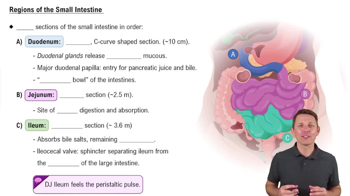
Regions of the Small Intestine

Identification of Intestinal Segments in Diagrams

Recognizing the position and features of each small intestine segment in anatomical figures is essential. The duodenum is the first segment connected to the stomach, followed by the jejunum in the middle, and the ileum as the final part leading to the large intestine.
Recommended video:
Guided course
3:06
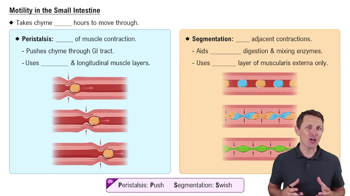
Motility in the Small Intestine

Functional Differences Among Segments

Each segment of the small intestine plays a specific role: the duodenum primarily receives digestive enzymes, the jejunum is mainly involved in nutrient absorption, and the ileum absorbs vitamin B12 and bile salts, which helps in understanding their anatomical distinctions.
Recommended video:
06:04
Functional Groups