How does a cytotoxic T cell destroy another cell displaying antigens bound to class I MHC proteins?
Ch. 22 The Lymphatic System and Immunity

Martini, Nath, Bartholomew12th EditionFundamentals of Anatomy and PhysiologyISBN: 9780137854011Not the one you use?Change textbook
All textbooks
Martini, Nath, Bartholomew 12th Edition
Ch. 22 The Lymphatic System and Immunity
Problem 16
Martini, Nath, Bartholomew 12th Edition
Ch. 22 The Lymphatic System and Immunity
Problem 16Chapter 22, Problem 16
Compared with innate defenses, adaptive defenses
(a) Do not distinguish between one threat and another
(b) Are always present at birth
(c) Protect against threats on an individual basis
(d) Deny the entry of pathogens to the body
Verified step by step guidance1
Step 1: Understand the difference between innate and adaptive defenses. Innate defenses are the body's first line of defense and respond to threats in a general, non-specific way, while adaptive defenses are specific and tailored to particular pathogens.
Step 2: Analyze option (a): 'Do not distinguish between one threat and another.' This describes innate defenses, which respond broadly, so adaptive defenses actually do distinguish between different threats.
Step 3: Analyze option (b): 'Are always present at birth.' Innate defenses are present at birth, but adaptive defenses develop and improve after exposure to specific pathogens.
Step 4: Analyze option (c): 'Protect against threats on an individual basis.' Adaptive defenses are specific to particular pathogens and provide targeted protection, which matches this description.
Step 5: Analyze option (d): 'Deny the entry of pathogens to the body.' This is primarily a function of innate defenses like skin and mucous membranes, not adaptive defenses.

Verified video answer for a similar problem:
This video solution was recommended by our tutors as helpful for the problem above.
Was this helpful?
Key Concepts
Here are the essential concepts you must grasp in order to answer the question correctly.
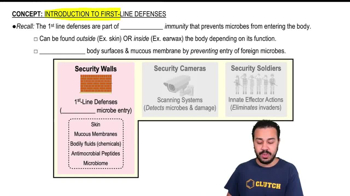
Innate Defenses
Innate defenses are the body's first line of defense against pathogens, present from birth. They provide a general, non-specific protection by recognizing common features of pathogens but do not target specific threats individually.
Recommended video:
First-Line Defenses
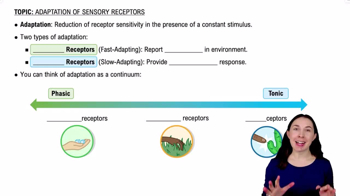
Adaptive Defenses
Adaptive defenses are specialized immune responses that develop after exposure to specific pathogens. They recognize and remember individual threats, allowing for targeted and more effective protection upon subsequent encounters.
Recommended video:
Adaptation
Specificity and Memory in Immunity
Adaptive immunity is characterized by its ability to distinguish between different pathogens and remember them. This specificity enables the immune system to mount a tailored response to each threat and improve defense over time.
Recommended video:
Water’s High Specific Heat
Related Practice
Textbook Question
1
views
Textbook Question
Blocking the antigen receptors on the surface of lymphocytes would interfere with
(a) Phagocytosis of the antigen
(b) That lymphocyte's ability to produce antibodies
(c) Antigen recognition
(d) The ability of the lymphocyte to present antigen
(e) Opsonization of the antigen
6
views
Textbook Question
What seven defenses, present at birth, provide the body with the defensive capability known as innate (nonspecific) immunity?
1
views
Textbook Question
Compare and contrast the effects of complement with those of interferon.
Textbook Question
Give a function for each of the following:
(a) Cytotoxic T cells
(b) Helper T cells
(c) Regulatory T cells
(d) Plasma cells
(e) NK cells
1
views
Textbook Question
What are the three classes of lymphocytes, and where does each class originate?
2
views