Ch. 17 The Special Senses
Martini - Fundamentals of Anatomy & Physiology 11th Edition
Martini, Nath, Bartholomew11th EditionFundamentals of Anatomy & PhysiologyISBN: 9780136874089Not the one you use?Change textbook
Chapter 17, Problem 5

The basic receptors in the internal ear are the
(a) Utricles
(b) Saccules
(c) Hair cells
(d) Supporting cells
(e) Ampullae

Verified step by step guidance
1
Understand that the internal ear contains specialized sensory receptors responsible for detecting sound and balance.
Recognize that the basic sensory receptors in the internal ear are specialized cells that convert mechanical stimuli into nerve impulses.
Recall that hair cells are the primary sensory receptors in the internal ear, located within structures such as the cochlea and vestibular apparatus.
Note that utricles, saccules, and ampullae are parts of the vestibular system that contain hair cells but are not themselves the receptors.
Conclude that the correct answer is (c) Hair cells, as they are the fundamental receptor cells responsible for detecting auditory and balance stimuli.

Verified video answer for a similar problem:

This video solution was recommended by our tutors as helpful for the problem above.
Was this helpful?

Key Concepts

Here are the essential concepts you must grasp in order to answer the question correctly.

Structure of the Internal Ear

The internal ear consists of the cochlea, vestibule, and semicircular canals. It houses sensory organs responsible for hearing and balance, including specialized receptor cells that detect sound vibrations and head movements.
Recommended video:
6:14
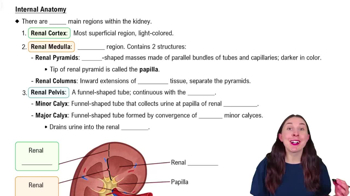
Internal Anatomy

Hair Cells as Sensory Receptors

Hair cells are the primary sensory receptors in the internal ear. They have hair-like projections called stereocilia that convert mechanical stimuli from sound waves or head movements into electrical signals sent to the brain.
Recommended video:
2:47
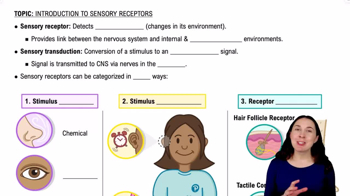
Sensory Receptors

Role of Utricles, Saccules, and Ampullae

Utricles and saccules detect linear acceleration and gravity, while ampullae in semicircular canals detect rotational movements. These structures contain hair cells embedded in gelatinous material that respond to motion, aiding in balance and spatial orientation.
Recommended video:
1:02
Anatomy of the Female Reproductive System Example 2