Ch. 17 The Special Senses
Martini - Fundamentals of Anatomy & Physiology 11th Edition
Martini, Nath, Bartholomew11th EditionFundamentals of Anatomy & PhysiologyISBN: 9780136874089Not the one you use?Change textbook
Chapter 17, Problem 2

A reduction in sensitivity in the presence of a constant stimulus is
(a) Transduction
(b) Sensory coding
(c) Line labeling
(d) Adaptation

Verified step by step guidance
1
Step 1: Understand the key terms in the question. The problem asks about a reduction in sensitivity when a constant stimulus is present.
Step 2: Define each option to clarify their meanings: (a) Transduction is the process of converting a stimulus into an electrical signal in the nervous system.
(b) Sensory coding refers to how sensory information is represented and transmitted by neurons.
(c) Line labeling is the concept that each nerve fiber carries information about a specific type of stimulus or modality.
(d) Adaptation is the process by which sensory receptors become less sensitive to a constant stimulus over time.
Step 3: Identify which definition matches the description of reduced sensitivity to a constant stimulus. This is characteristic of adaptation, where receptors decrease their response to unchanging stimuli.

Verified video answer for a similar problem:

This video solution was recommended by our tutors as helpful for the problem above.
Was this helpful?

Key Concepts

Here are the essential concepts you must grasp in order to answer the question correctly.

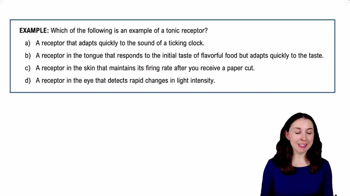
Sensory Adaptation

Sensory adaptation refers to the process where sensory receptors decrease their sensitivity to a constant or unchanging stimulus over time, allowing the nervous system to focus on changes in the environment rather than constant background stimuli.
Recommended video:
1:17
Adaptation of Sensory Receptors Example 1

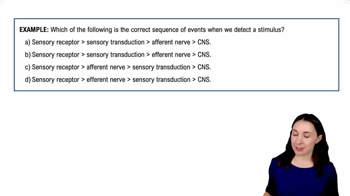
Transduction

Transduction is the conversion of physical or chemical stimuli from the environment into electrical signals by sensory receptors, which the brain can then interpret as sensations.
Recommended video:
1:36
Introduction to Sensory Receptors Example 1

Sensory Coding

Sensory coding involves the way sensory systems represent different types of stimuli through patterns of neural activity, such as frequency or location of signals, enabling the brain to distinguish between various sensory inputs.
Recommended video:
01:28
Genetic Code