Ch. 3 Cells: The Living Units
Marieb - Human Anatomy & Physiology 11th Edition
Marieb, Hoehn11th EditionHuman Anatomy & PhysiologyISBN: 9780136874034Not the one you use?Change textbook
Chapter 3, Problem 22

A 'red-hot' bacterial infection of the intestinal tract irritates the intestinal cells and interferes with digestion. Such a condition is often accompanied by diarrhea, which causes loss of body water. On the basis of what you have learned about osmotic water flows, explain why diarrhea may occur.

Verified step by step guidance
1
Understand that diarrhea involves the rapid movement of water into the intestinal lumen, leading to loose or watery stools.
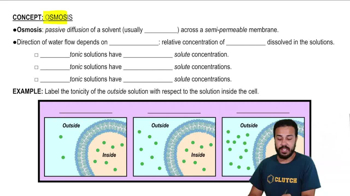
Recall that osmotic water flow occurs when there is a difference in solute concentration across a membrane, causing water to move toward the area with higher solute concentration to balance the osmotic pressure.
Recognize that during a bacterial infection, the intestinal cells become irritated and damaged, which can impair their ability to absorb nutrients and electrolytes properly.
Because digestion and absorption are disrupted, undigested solutes (such as sugars, salts, and other molecules) remain in the intestinal lumen, increasing its osmolarity compared to the surrounding tissues.
As a result, water moves osmotically from the body tissues into the intestinal lumen to try to equalize solute concentrations, leading to increased water content in the intestines and causing diarrhea.

Verified video answer for a similar problem:

This video solution was recommended by our tutors as helpful for the problem above.
Video duration:
3m
Was this helpful?

Key Concepts

Here are the essential concepts you must grasp in order to answer the question correctly.

Osmosis and Osmotic Pressure

Osmosis is the movement of water across a semipermeable membrane from an area of low solute concentration to high solute concentration. Osmotic pressure is the force that drives this water movement, balancing solute concentrations on both sides of the membrane.
Recommended video:
05:59
Osmosis

Intestinal Cell Function and Absorption

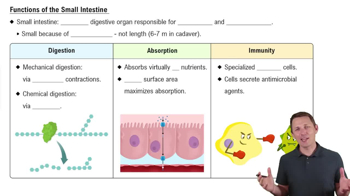
Intestinal cells absorb nutrients and water from digested food. When these cells are irritated or damaged, their ability to absorb solutes and water decreases, disrupting normal fluid balance in the intestines.
Recommended video:
Guided course
3:44
Functions of the Small Intestine

Cause of Diarrhea in Osmotic Imbalance

If solutes remain in the intestinal lumen due to poor absorption, water moves into the intestines by osmosis to balance solute concentration. This excess water causes diarrhea, leading to loss of body water and dehydration.
Recommended video:
1:01
Renal Physiology Step 2: Tubular Reabsorption Example 3