
Fresh water is a precious natural resource in Florida and it is said that supplies are dwindling. Desalinizing (removing salt from) ocean water has been recommended as a solution to the problem. Why shouldn't we drink salt water?
Ch. 3 Cells: The Living Units

Marieb, Hoehn11th EditionHuman Anatomy & PhysiologyISBN: 9780136874034Not the one you use?Change textbook
Chapter 3, Problem 24
Explain why alcoholics are likely to have much more smooth ER than teetotalers.
Verified step by step guidance1
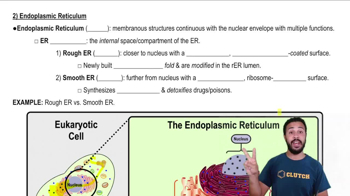
Understand the function of the smooth endoplasmic reticulum (smooth ER) in cells, which is primarily involved in lipid synthesis and detoxification processes, including the metabolism of drugs and toxins.
Recognize that alcohol (ethanol) is a toxin that the body needs to metabolize and detoxify, primarily in liver cells where smooth ER is abundant.
Know that chronic alcohol consumption induces the proliferation of smooth ER in liver cells to increase the capacity for metabolizing alcohol and other toxins, a process called enzyme induction.
Explain that this increase in smooth ER allows alcoholics to process larger amounts of alcohol more efficiently, but it also reflects cellular adaptation to the increased demand for detoxification.
Contrast this with teetotalers, who do not consume alcohol and therefore have less need for enhanced detoxification, resulting in fewer smooth ER structures in their liver cells.

Verified video answer for a similar problem:
This video solution was recommended by our tutors as helpful for the problem above.
Video duration:
2mWas this helpful?
Key Concepts
Here are the essential concepts you must grasp in order to answer the question correctly.
Smooth Endoplasmic Reticulum (Smooth ER) Structure and Function
The smooth ER is a cellular organelle involved in lipid synthesis, detoxification, and metabolism of various substances. Unlike rough ER, it lacks ribosomes and is abundant in cells that process toxins or produce lipids, adapting its size based on cellular needs.
Recommended video:
Endoplasmic Reticulum
Role of Smooth ER in Alcohol Metabolism
Smooth ER contains enzymes like cytochrome P450 that metabolize alcohol and other drugs. Chronic alcohol consumption induces the proliferation of smooth ER to increase the cell's capacity to detoxify ethanol, leading to an expanded smooth ER network in liver cells.
Recommended video:
Introduction to Metabolism
Cellular Adaptation to Chronic Alcohol Exposure
Cells adapt to repeated exposure to toxins by increasing organelles involved in detoxification. In alcoholics, liver cells respond to continuous ethanol presence by producing more smooth ER, enhancing their ability to metabolize alcohol but also potentially causing cellular stress.
Recommended video:
Review of Adaptive Immunity
Related Practice
Textbook Question
2
views
Textbook Question
Cell division typically yields two daughter cells, each with one nucleus. How is the occasional binucleate condition of liver cells explained?
4
views
Textbook Question
In their anatomy lab, many students are exposed to the chemical preservatives phenol, formaldehyde, and alcohol. Our cells break down these toxins very effectively. What cellular organelle is responsible for this?
2
views
Textbook Question
A 'red-hot' bacterial infection of the intestinal tract irritates the intestinal cells and interferes with digestion. Such a condition is often accompanied by diarrhea, which causes loss of body water. On the basis of what you have learned about osmotic water flows, explain why diarrhea may occur.
1
views
