
Ch. 9 The Muscular System
Amerman- Human Anatomy & Physiology 3e
Amerman3rd EditionHuman Anatomy & PhysiologyISBN: 9780138247201, 9780138247928, 9780138201814Not the one you use?Change textbook
Chapter 9, Problem L3.1

Mr. Bell presents with the inability to move certain muscles on one side of his face. You ask him to make various facial expressions and find that on his right side he is unable to purse his lips, pull in his cheeks, elevate his upper lip, and smirk. What muscles is Mr. Bell unable to contract?

Verified step by step guidance
1
Step 1: Identify the muscles responsible for the specific facial expressions Mr. Bell is unable to perform. For pursing the lips, the orbicularis oris muscle is primarily involved.
Step 2: Determine the muscle responsible for pulling in the cheeks. This action is performed by the buccinator muscle, which is located in the cheek area.
Step 3: Analyze the muscle responsible for elevating the upper lip. The levator labii superioris muscle is responsible for this movement.
Step 4: Identify the muscle involved in smirking. The zygomaticus major muscle is responsible for pulling the corners of the mouth upward and outward during a smirk.
Step 5: Conclude that Mr. Bell's inability to contract these muscles suggests dysfunction in the facial nerve (cranial nerve VII), which innervates these muscles and controls facial expressions.

Verified video answer for a similar problem:

This video solution was recommended by our tutors as helpful for the problem above.
Was this helpful?

Key Concepts

Here are the essential concepts you must grasp in order to answer the question correctly.

Facial Muscles

Facial muscles are a group of muscles that control facial expressions. They are primarily innervated by the facial nerve (cranial nerve VII) and include muscles such as the orbicularis oris, buccinator, and zygomaticus. Dysfunction in these muscles can lead to characteristic signs of facial weakness or paralysis, as seen in conditions like Bell's palsy.
Recommended video:
Guided course
6:30
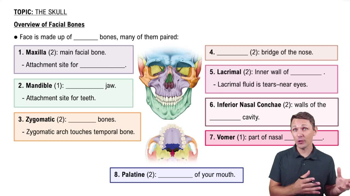
Overview of Facial Bones

Cranial Nerve VII (Facial Nerve)

The facial nerve, or cranial nerve VII, is responsible for the motor control of the muscles of facial expression. It also carries sensory information from the taste buds of the anterior two-thirds of the tongue and provides parasympathetic innervation to salivary and lacrimal glands. Damage to this nerve can result in weakness or paralysis of the facial muscles on the affected side.
Recommended video:
Guided course
2:25
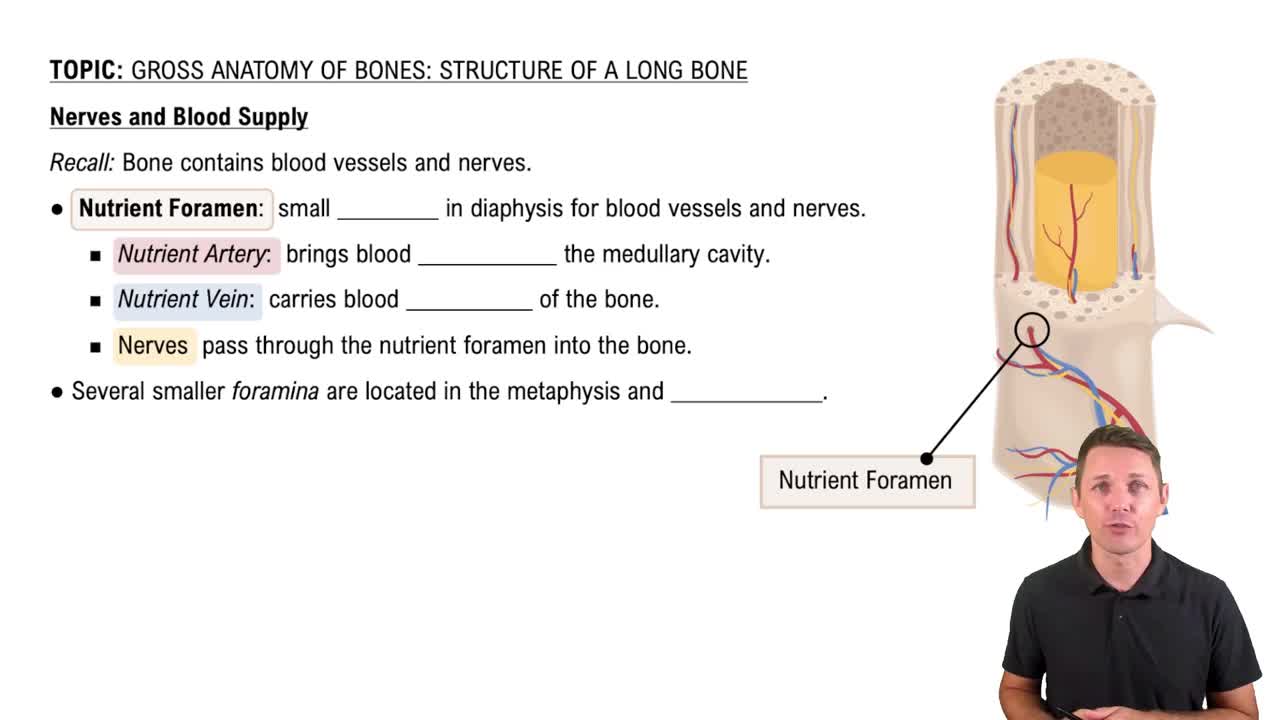
Nerves and Blood Supply

Bell's Palsy

Bell's palsy is a condition characterized by sudden, unilateral facial weakness or paralysis, often due to inflammation of the facial nerve. The exact cause is often unknown, but it may be linked to viral infections. Symptoms typically include difficulty with facial expressions, drooping of the mouth, and loss of the ability to close the eye on the affected side.
Recommended video:
06:49
Biological Membranes
Related Practice
Textbook Question

Ms. Cho presents with muscle pain in the area around her anterior neck and superior chest. She explains that she has had a respiratory infection over the past 2 weeks that made it hard for her to breathe. What is likely causing her muscle soreness? (Hint: Remember that the origin and insertion of some muscles can switch and that one likely has to breathe more deeply with a respiratory infection.)

2
views
Textbook Question

The action of the biceps brachii muscle on the hinge joint of the elbow is an example of which kind of lever system?

a. First class

b. Second class

c. Third class

d. Fourth class

1
views
Textbook Question

Which function is being fulfilled by a muscle that holds a bone steady during movement?

a. Antagonist

b. Synergist

c. Supinator

d. Fixator

1
views
Textbook Question

Elise is a competitive gymnast who strained muscles in her left lower limb doing a tumbling pass. She has pain with extension of her leg and inversion of her foot. Which muscles did she potentially strain?

1
views
Textbook Question

Ms. Hendrix suffered a severe hip fracture that required hip replacement surgery. After an extended recovery period, she is undergoing physical therapy to regain strength and mobility.

Which muscles were likely affected by the hip replacement surgery, and to which parts of the bone do they attach?

1
views
Textbook Question

Ms. Hendrix suffered a severe hip fracture that required hip replacement surgery. After an extended recovery period, she is undergoing physical therapy to regain strength and mobility.

Which actions could Ms. Hendrix perform to strengthen these muscles?

1
views