
Ch. 9 The Muscular System
Amerman- Human Anatomy & Physiology 3e
Amerman3rd EditionHuman Anatomy & PhysiologyISBN: 9780138247201, 9780138247928, 9780138201814Not the one you use?Change textbook
Chapter 9, Problem L3.3

Elise is a competitive gymnast who strained muscles in her left lower limb doing a tumbling pass. She has pain with extension of her leg and inversion of her foot. Which muscles did she potentially strain?

Verified step by step guidance
1
Step 1: Understand the movements involved. Extension of the leg primarily involves the quadriceps group, while inversion of the foot involves muscles like the tibialis anterior and tibialis posterior. Pain during these movements suggests strain in muscles responsible for these actions.
Step 2: Identify the muscles responsible for leg extension. The quadriceps group includes the rectus femoris, vastus lateralis, vastus medialis, and vastus intermedius. These muscles are located in the anterior thigh and are key in extending the knee joint.
Step 3: Identify the muscles responsible for foot inversion. The tibialis anterior and tibialis posterior are the primary muscles involved in inversion. The tibialis anterior is located in the anterior compartment of the leg, while the tibialis posterior is in the posterior compartment.
Step 4: Consider the location of the pain. Elise's pain is in her left lower limb, which includes the thigh and leg. This suggests that the strain could involve muscles in both the anterior thigh (quadriceps) and the leg compartments (tibialis anterior/posterior).
Step 5: Conclude that Elise potentially strained her quadriceps group (for leg extension) and tibialis anterior or tibialis posterior (for foot inversion). Further examination, such as palpation or imaging, would be needed to confirm the specific muscles affected.

Verified video answer for a similar problem:

This video solution was recommended by our tutors as helpful for the problem above.
Was this helpful?

Key Concepts

Here are the essential concepts you must grasp in order to answer the question correctly.

Muscle Anatomy of the Lower Limb

Understanding the anatomy of the lower limb is crucial for identifying which muscles may be involved in Elise's injury. Key muscle groups include the quadriceps, hamstrings, and calf muscles, each playing a role in leg extension and foot movement.
Recommended video:
Guided course
2:16
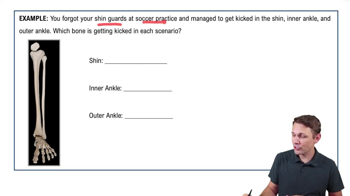
Bone of the Lower Limb Example 1

Muscle Strain Mechanism

A muscle strain occurs when muscle fibers are overstretched or torn, often due to sudden movements or excessive force. In gymnastics, activities like tumbling can lead to strains, particularly in muscles responsible for explosive movements and stabilization.
Recommended video:
Guided course
4:36
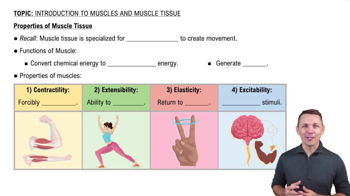
Properties of Muscle Tissue

Functional Movements: Extension and Inversion

Extension of the leg primarily involves the quadriceps, while inversion of the foot engages the tibialis posterior and other muscles. Recognizing these movements helps pinpoint which muscles are likely strained based on Elise's symptoms.
Recommended video:
06:04
Functional Groups
Related Practice
Textbook Question

Mr. Bell presents with the inability to move certain muscles on one side of his face. You ask him to make various facial expressions and find that on his right side he is unable to purse his lips, pull in his cheeks, elevate his upper lip, and smirk. What muscles is Mr. Bell unable to contract?

2
views
Textbook Question

Explain why strengthening the levator ani muscle may help improve bladder and bowel continence (voluntary control over urination and defecation).

1
views
Textbook Question

Ms. Hendrix suffered a severe hip fracture that required hip replacement surgery. After an extended recovery period, she is undergoing physical therapy to regain strength and mobility.

Which muscles were likely affected by the hip replacement surgery, and to which parts of the bone do they attach?

1
views
Textbook Question

Ms. Hendrix suffered a severe hip fracture that required hip replacement surgery. After an extended recovery period, she is undergoing physical therapy to regain strength and mobility.

Which actions could Ms. Hendrix perform to strengthen these muscles?

1
views
Textbook Question

Match the term with its description:

_____Brevis     

_____Digitorum     

_____Hallucis     

_____Rectus     

_____Flexor      

_____Pronator

a. Related to the fingers/toes

b. Straight

c. Short

d. Decreases the angle between bones

e. Turns palm down

f. Related to the hallux (great toe)

1
views
Textbook Question

Chris is training for his black belt in karate and is working on developing a stronger punch. Which muscles do you recommend that he strengthen to improve his punch? Explain.

2
views