
Ch. 9 The Muscular System
Amerman- Human Anatomy & Physiology 3e
Amerman3rd EditionHuman Anatomy & PhysiologyISBN: 9780138247201, 9780138247928, 9780138201814Not the one you use?Change textbook
Chapter 9, Problem L3.2

Ms. Cho presents with muscle pain in the area around her anterior neck and superior chest. She explains that she has had a respiratory infection over the past 2 weeks that made it hard for her to breathe. What is likely causing her muscle soreness? (Hint: Remember that the origin and insertion of some muscles can switch and that one likely has to breathe more deeply with a respiratory infection.)

Verified step by step guidance
1
Understand the context: Ms. Cho has been experiencing muscle pain in her anterior neck and superior chest, which coincides with a respiratory infection that made breathing difficult. This suggests that her muscles involved in respiration may be overworked.
Identify the muscles involved: The primary muscles of respiration include the diaphragm and intercostal muscles. However, during labored breathing, accessory muscles such as the sternocleidomastoid and pectoralis major may become active to assist in deeper inhalation.
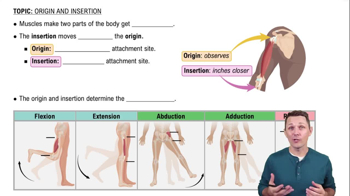
Explain the concept of origin and insertion switching: Normally, the sternocleidomastoid originates at the sternum and clavicle and inserts at the mastoid process of the skull. During labored breathing, the insertion and origin can switch, allowing the muscle to elevate the rib cage to assist in breathing.
Relate the muscle soreness to overuse: With a respiratory infection, Ms. Cho likely had to breathe more deeply and frequently, causing her accessory muscles (e.g., sternocleidomastoid and pectoralis major) to work harder than usual. This overuse can lead to muscle soreness in the anterior neck and superior chest.
Conclude the reasoning: The muscle soreness is likely due to the overuse of accessory respiratory muscles during labored breathing caused by the respiratory infection. This is a common occurrence when the body compensates for difficulty in breathing.

Verified video answer for a similar problem:

This video solution was recommended by our tutors as helpful for the problem above.
Was this helpful?

Key Concepts

Here are the essential concepts you must grasp in order to answer the question correctly.

Muscle Origin and Insertion

Muscle origin refers to the fixed attachment point of a muscle, while insertion is the point that moves during contraction. In certain conditions, such as respiratory infections, the mechanics of breathing can alter the typical function of muscles, leading to soreness. Understanding how these points can shift during abnormal respiratory patterns is crucial for diagnosing muscle pain.
Recommended video:
Guided course
5:39
Origin and Insertion

Respiratory Mechanics

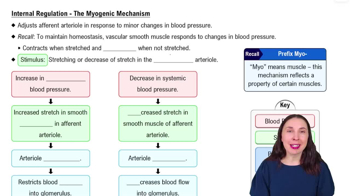
Respiratory mechanics involve the physical processes of breathing, including the expansion and contraction of the thoracic cavity. During a respiratory infection, individuals may need to engage accessory muscles more intensely to facilitate deeper breaths, which can lead to muscle fatigue and soreness, particularly in the neck and chest areas.
Recommended video:
3:02
Internal Regulation - The Myogenic Mechanism

Referred Pain

Referred pain occurs when discomfort is perceived in a location different from its source. In the context of respiratory infections, muscle soreness in the neck and chest may be referred from the diaphragm or intercostal muscles, which are heavily involved in breathing. Recognizing this phenomenon helps in understanding the broader implications of muscle pain in patients with respiratory issues.
Recommended video:
1:36
The Cerebrum Example 3
Related Practice
Textbook Question

Mr. Bell presents with the inability to move certain muscles on one side of his face. You ask him to make various facial expressions and find that on his right side he is unable to purse his lips, pull in his cheeks, elevate his upper lip, and smirk. What muscles is Mr. Bell unable to contract?

2
views
Textbook Question

Mark the following statements as true or false. If the statement is false, correct it to make a true statement.

The main action of the zygomaticus major and minor muscles is to pull the corners of the mouth up to produce smiling.

2
views
Textbook Question

The action of the biceps brachii muscle on the hinge joint of the elbow is an example of which kind of lever system?

a. First class

b. Second class

c. Third class

d. Fourth class

1
views
Textbook Question

Which function is being fulfilled by a muscle that holds a bone steady during movement?

a. Antagonist

b. Synergist

c. Supinator

d. Fixator

1
views
Textbook Question

Ms. Hendrix suffered a severe hip fracture that required hip replacement surgery. After an extended recovery period, she is undergoing physical therapy to regain strength and mobility.

Which muscles were likely affected by the hip replacement surgery, and to which parts of the bone do they attach?

1
views
Textbook Question

Ms. Hendrix suffered a severe hip fracture that required hip replacement surgery. After an extended recovery period, she is undergoing physical therapy to regain strength and mobility.

Which actions could Ms. Hendrix perform to strengthen these muscles?

1
views