
Textbook Question
The part of the epiphysis that does not ossify during a person's lifetime is the:
a. Articular surface
b. Secondary ossification center
c. Diaphyseal notch
d. Nutrient foramen
1
views

 Verified step by step guidance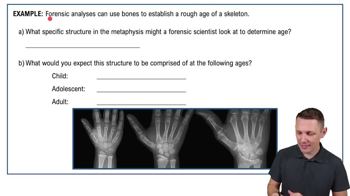
 3:22
3:22 3:22
3:22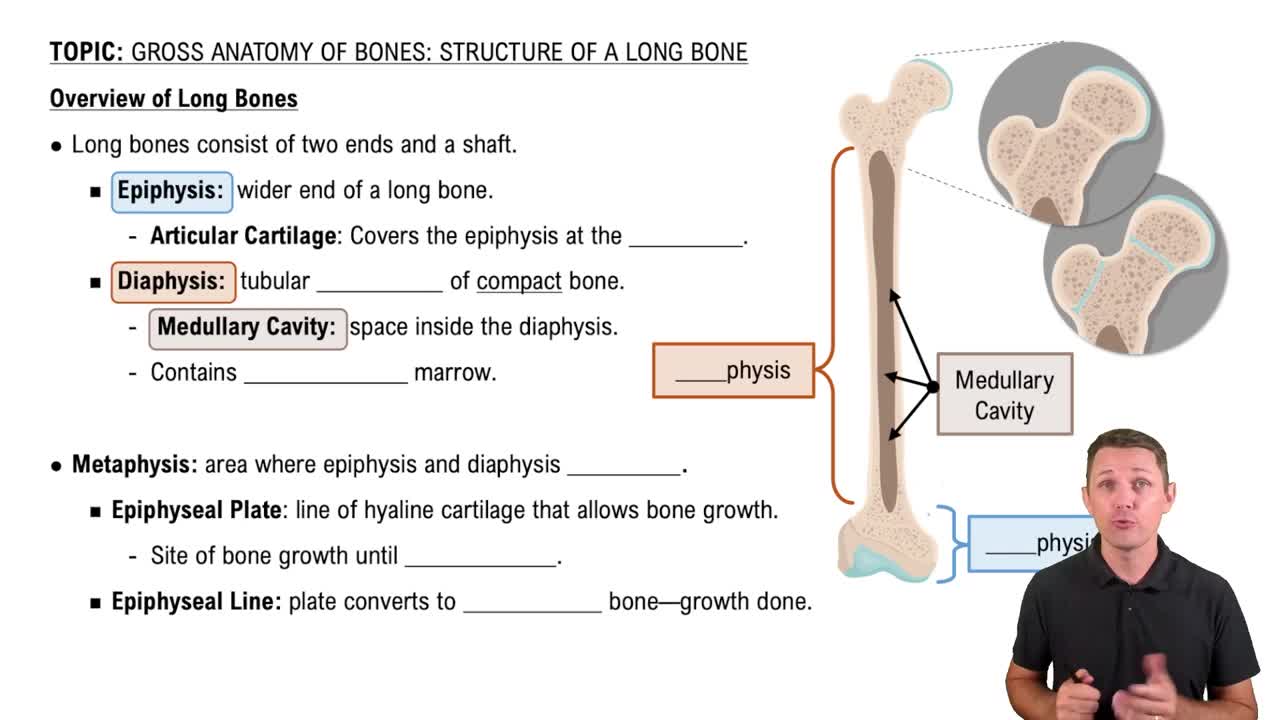 6:19
6:19The part of the epiphysis that does not ossify during a person's lifetime is the:
a. Articular surface
b. Secondary ossification center
c. Diaphyseal notch
d. Nutrient foramen
Explain the effect that the following hormones have on growth of bone tissue:
b. Testosterone
Correctly order the following steps of bone growth in length by placing a 1 by the first step, a 2 by the second step, and so on.
Calcified cartilage is replaced with bone in the zone of ossification.
Chondrocytes in the zone of proliferation divide by mitosis.
Chondrocytes enter the zone of calcification and die as their matrix calcifies.
Chondrocytes enlarge and cease dividing.
What is the difference between a primary and secondary ossification center in a long bone?
Explain the effect that the following hormones have on the growth of bone tissue:
a. Growth hormone
Of the following statements, identify those that are properties of intramembranous ossification, endochondral ossification, or both.
a. The bone is formed via a hyaline cartilage model.
b. Bone tissue forms from ossification centers.
c. Bone forms from within a mesenchyme membrane.
d. The early spongy bone is formed, after which the early compact bone develops.
e. The original primary bone is replaced with secondary bone.
f. A bone collar forms, followed by the early spongy bone.