
A patient is admitted to the hospital and given intravenous (IV) fluids. Four hours later, the patient complains that his mouth and eyes feel dry. You notice that he displays signs of dehydration, and when you check his IV, you see that he was given the wrong kind of fluids. Were these fluids likely hypotonic, isotonic, or hypertonic? Explain.
Ch. 3 The Cell
Amerman3rd EditionHuman Anatomy & PhysiologyISBN: 9780138247201, 9780138247928, 9780138201814Not the one you use?Change textbook
Chapter 3, Problem L3A4
What effect would the hypothetical poison of question 3 have on other functions of the cell? Explain.
Verified step by step guidance1
Identify the specific mechanism of action of the hypothetical poison described in question 3. For example, determine whether it affects cellular respiration, protein synthesis, membrane transport, or another cellular function.
Understand the role of the affected cellular process in maintaining homeostasis. For instance, if the poison disrupts ATP production, consider how energy-dependent processes like active transport or muscle contraction would be impacted.
Analyze how the disruption of the targeted cellular function would cascade to other systems within the cell. For example, if protein synthesis is inhibited, the cell may fail to produce enzymes necessary for metabolic reactions.
Consider the broader implications for tissue and organ function. For example, if the poison affects nerve cells, it could impair communication within the nervous system, leading to systemic effects.
Relate the cellular dysfunction to potential symptoms or outcomes in the organism. For instance, if the poison disrupts ion gradients, it could lead to issues like muscle weakness or cardiac arrhythmias.
Key Concepts
Here are the essential concepts you must grasp in order to answer the question correctly.
Cellular Functions
Cellular functions refer to the various processes that occur within a cell to maintain life, including metabolism, energy production, and communication. Each function is interconnected, meaning that a disruption in one area can affect others. Understanding these functions is crucial to predicting how a poison might impact overall cell health and activity.
Recommended video:
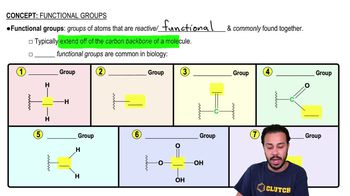
Functional Groups
Toxicology
Toxicology is the study of the adverse effects of substances on living organisms. It examines how poisons interact with biological systems, including their mechanisms of action and potential cellular damage. Knowledge of toxicology is essential for assessing how a hypothetical poison could disrupt cellular functions and lead to broader physiological consequences.
Cell Signaling
Cell signaling involves the communication processes that govern basic cellular activities and coordinate cell actions. Signals can be chemical or physical, and they play a critical role in regulating functions such as growth, metabolism, and apoptosis. A poison may interfere with these signaling pathways, leading to impaired cellular responses and dysfunction.
Recommended video:
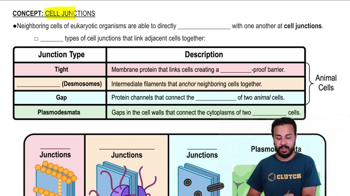
Cell Junctions
Related Practice
Textbook Question
1
views
Textbook Question
A hypothetical poison prevents transcription factors from binding to the gene for tubulin proteins. What impact would this have on mitosis, and why?
1
views
Textbook Question
Epithelial cells of the kidneys have pumps that drive the transcellular transport of sodium ions.
The movement of sodium ions drives the transcellular transport of water. Explain why water follows sodium. (Connects to Chapter 3)
1
views
Textbook Question
What are the two fluid compartments in the body, and how are they kept separate?
1
views
Textbook Question
Explain how the form of each of the following structures is related to its function:
Intermediate filaments
2
views
Textbook Question
Write a single sentence, using no more than 25 words, to summarize each of the following cellular processes:
Mitosis
