
A popular science fiction program once had an episode that featured an 'intron virus' that 'turned on' the introns in the genes, causing the synthesis of abnormal proteins. The episode may have been entertaining, but its premise had a large flaw about the nature of introns. What was the flaw?
Ch. 3 The Cell
Amerman3rd EditionHuman Anatomy & PhysiologyISBN: 9780138247201, 9780138247928, 9780138201814Not the one you use?Change textbook
Chapter 3, Problem L3.A3
A hypothetical poison prevents transcription factors from binding to the gene for tubulin proteins. What impact would this have on mitosis, and why?
Verified step by step guidance1
Understand the role of tubulin proteins in mitosis: Tubulin is a key component of microtubules, which form the mitotic spindle. The spindle is essential for separating chromosomes during cell division.
Recognize the importance of transcription factors: Transcription factors are proteins that bind to specific DNA sequences to regulate the expression of genes, including those coding for tubulin proteins.
Analyze the effect of the poison: If transcription factors cannot bind to the gene for tubulin proteins, the production of tubulin will be inhibited. This means microtubules cannot form properly, disrupting the mitotic spindle assembly.
Connect the disruption to mitosis: Without a functional mitotic spindle, chromosomes cannot be accurately separated during mitosis. This would lead to errors in cell division, such as unequal distribution of genetic material or failure of the cell to divide.
Conclude the impact: The poison would effectively halt or severely impair mitosis, preventing normal cell division and potentially leading to cell death or dysfunction.

Verified video answer for a similar problem:
This video solution was recommended by our tutors as helpful for the problem above.
Was this helpful?
Key Concepts
Here are the essential concepts you must grasp in order to answer the question correctly.
Transcription Factors
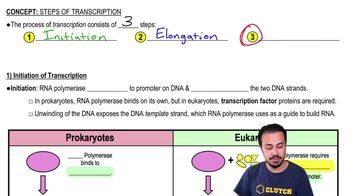
Transcription factors are proteins that bind to specific DNA sequences, regulating the transcription of genes. They play a crucial role in initiating and controlling the expression of genes, including those necessary for cell structure and function. In the context of tubulin proteins, transcription factors are essential for producing the mRNA that encodes these proteins, which are vital for forming microtubules.
Recommended video:
1) Initiation of Transcription
Tubulin Proteins
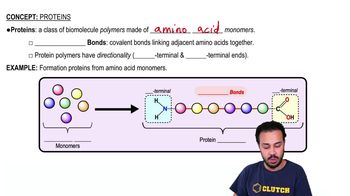
Tubulin proteins are the building blocks of microtubules, which are part of the cytoskeleton in eukaryotic cells. They are essential for various cellular processes, including maintaining cell shape, enabling intracellular transport, and facilitating mitosis by forming the mitotic spindle. Without adequate tubulin production, the formation of microtubules would be impaired, disrupting normal cell division.
Recommended video:
Proteins
Mitosis
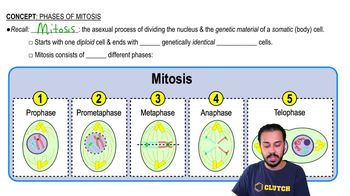
Mitosis is the process of cell division that results in two genetically identical daughter cells. It involves several stages, including prophase, metaphase, anaphase, and telophase, during which the chromosomes are accurately segregated into the daughter cells. The proper formation of the mitotic spindle, which relies on tubulin proteins, is critical for ensuring that chromosomes are evenly distributed, making tubulin's role in mitosis vital.
Recommended video:
Phases of Mitosis
Related Practice
Textbook Question
1
views
Textbook Question
Epithelial cells of the kidneys have pumps that drive the transcellular transport of sodium ions.
The movement of sodium ions drives the transcellular transport of water. Explain why water follows sodium. (Connects to Chapter 3)
1
views
Textbook Question
What effect would the hypothetical poison of question 3 have on other functions of the cell? Explain.
2
views
Textbook Question
Write a single sentence, using no more than 25 words, to summarize each of the following cellular processes:
Primary active transport
1
views
Textbook Question
Write a single sentence, using no more than 25 words, to summarize each of the following cellular processes:
DNA synthesis
1
views
Textbook Question
Write a single sentence, using no more than 25 words, to summarize each of the following cellular processes:
Mitosis
