
Ch. 3 The Cell
Amerman- Human Anatomy & Physiology 3e
Amerman3rd EditionHuman Anatomy & PhysiologyISBN: 9780138247201, 9780138247928, 9780138201814Not the one you use?Change textbook
Chapter 3, Problem L3.B5b

Epithelial cells of the kidneys have pumps that drive the transcellular transport of sodium ions.
The movement of sodium ions drives the transcellular transport of water. Explain why water follows sodium. (Connects to Chapter 3)

Verified step by step guidance
1
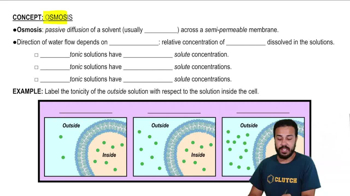
Understand the concept of osmosis: Osmosis is the movement of water across a semipermeable membrane from an area of lower solute concentration to an area of higher solute concentration. This principle is key to understanding why water follows sodium ions.
Recognize the role of sodium ions in creating a concentration gradient: Sodium ions are actively transported out of the epithelial cells of the kidneys into the interstitial fluid using sodium-potassium pumps. This creates a higher concentration of sodium ions in the interstitial fluid compared to the inside of the cells.
Explain how the concentration gradient affects water movement: The higher concentration of sodium ions in the interstitial fluid creates a hypertonic environment. Water moves from areas of lower solute concentration (inside the cells) to areas of higher solute concentration (interstitial fluid) to balance the osmotic pressure.
Connect the process to transcellular transport: The movement of sodium ions out of the epithelial cells drives the transcellular transport of water because water follows the osmotic gradient created by the sodium ion pumps.
Relate this mechanism to kidney function: This process is essential for the kidneys to regulate water and electrolyte balance in the body, ensuring proper hydration and maintaining homeostasis.

Verified video answer for a similar problem:

This video solution was recommended by our tutors as helpful for the problem above.
Was this helpful?

Key Concepts

Here are the essential concepts you must grasp in order to answer the question correctly.

Osmosis

Osmosis is the passive movement of water across a semipermeable membrane from an area of lower solute concentration to an area of higher solute concentration. In the context of kidney epithelial cells, when sodium ions are actively transported out of the cells, it creates a higher concentration of solutes outside the cell, prompting water to follow sodium to balance the solute concentrations.
Recommended video:
05:59
Osmosis

Active Transport

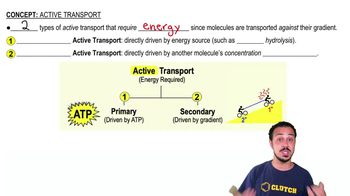
Active transport is the process by which cells move ions or molecules against their concentration gradient, requiring energy, typically in the form of ATP. In the kidneys, sodium ions are actively pumped out of epithelial cells, which is crucial for maintaining electrolyte balance and facilitating the subsequent movement of water.
Recommended video:
02:37
Active Transport

Transcellular Transport

Transcellular transport refers to the movement of substances across the epithelial cells, involving both passive and active mechanisms. In the kidneys, sodium ions are transported transcellularly, and this movement is essential for driving water reabsorption, as water follows sodium through osmosis, thereby influencing fluid balance in the body.
Recommended video:
02:37
Active Transport