Ch. 3 The Cell
Amerman- Human Anatomy & Physiology 3e
Amerman3rd EditionHuman Anatomy & PhysiologyISBN: 9780138247201, 9780138247928, 9780138201814Not the one you use?Change textbook
Chapter 3, Problem 12

Our somatic cells' DNA is distributed among 46 ________ in the nucleus.
a. Nucleosomes
b. Chromatids
c. Nucleoli
d. Chromosomes

Verified step by step guidance
1
Understand the context: Somatic cells are any cells in the body that are not reproductive cells (sperm or egg). These cells contain the complete set of DNA necessary for the organism.
Recall the structure of DNA: DNA in somatic cells is organized into structures called chromosomes, which are located in the nucleus of the cell. Chromosomes are made of tightly coiled DNA and proteins.
Differentiate between the options: a) Nucleosomes are subunits of chromatin, consisting of DNA wrapped around histone proteins. b) Chromatids are one of the two identical halves of a replicated chromosome. c) Nucleoli are structures within the nucleus responsible for ribosome production. d) Chromosomes are the complete structures that contain DNA and are visible during cell division.
Focus on the question: The problem asks for the structure in the nucleus where DNA is distributed among 46 units. This number corresponds to the total number of chromosomes in human somatic cells (23 pairs).
Conclude the reasoning: Based on the explanation above, the correct answer is the structure that matches the description of chromosomes, as they are the carriers of DNA in somatic cells.

Verified video answer for a similar problem:

This video solution was recommended by our tutors as helpful for the problem above.
Was this helpful?

Key Concepts

Here are the essential concepts you must grasp in order to answer the question correctly.

Chromosomes

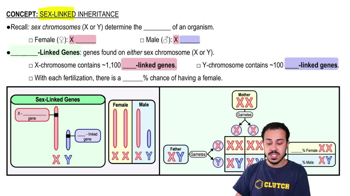
Chromosomes are long, thread-like structures made of DNA and proteins that carry genetic information. In humans, somatic cells contain 46 chromosomes, organized in 23 pairs. Each chromosome consists of a single DNA molecule that is tightly coiled and condensed, allowing for efficient packaging within the cell nucleus.
Recommended video:
04:17
Sex-Linked Inheritance

Nucleosomes

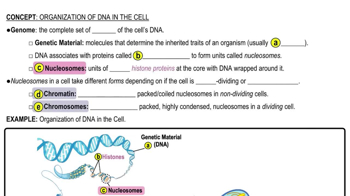
Nucleosomes are the fundamental units of DNA packaging in eukaryotic cells. They consist of a segment of DNA wrapped around a core of histone proteins, resembling 'beads on a string.' Nucleosomes help to organize DNA into a compact structure, facilitating its regulation and accessibility during processes like transcription and replication.
Recommended video:
06:51
Organization of DNA in the Cell

Chromatids

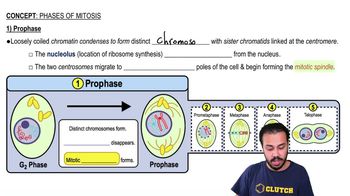
Chromatids are the two identical halves of a duplicated chromosome, which are joined together at a region called the centromere. During cell division, each chromatid is separated and distributed to daughter cells, ensuring that each new cell receives an identical set of chromosomes. Chromatids are crucial for the accurate segregation of genetic material.
Recommended video:
03:54
Prophase