Ch. 3 The Cell
Amerman- Human Anatomy & Physiology 3e
Amerman3rd EditionHuman Anatomy & PhysiologyISBN: 9780138247201, 9780138247928, 9780138201814Not the one you use?Change textbook
Chapter 3, Problem 11d

Mark the following statements about the cytoskeleton as true or false. If a statement is false, correct it to make a true statement.
Intermediate filaments are ropelike structures composed of tubulin proteins.

Verified step by step guidance
1
Understand the structure and function of intermediate filaments: Intermediate filaments are part of the cytoskeleton, which provides structural support to the cell. They are ropelike structures, but they are not composed of tubulin proteins. Instead, they are made of various proteins such as keratin, vimentin, or lamin, depending on the cell type.
Review the role of tubulin proteins: Tubulin proteins are the building blocks of microtubules, another component of the cytoskeleton. Microtubules are hollow, tube-like structures that play a role in intracellular transport, cell division, and maintaining cell shape.
Compare intermediate filaments and microtubules: Intermediate filaments are more flexible and provide tensile strength to the cell, while microtubules are rigid and involved in dynamic processes like mitosis and intracellular transport.
Evaluate the statement: The statement claims that intermediate filaments are composed of tubulin proteins. This is false because tubulin is specific to microtubules, not intermediate filaments.
Correct the false statement: Rewrite the statement to make it true. The corrected statement is: 'Intermediate filaments are ropelike structures composed of various proteins such as keratin, vimentin, or lamin, depending on the cell type.'

Verified video answer for a similar problem:

This video solution was recommended by our tutors as helpful for the problem above.
Was this helpful?

Key Concepts

Here are the essential concepts you must grasp in order to answer the question correctly.

Cytoskeleton

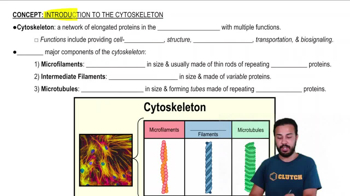
The cytoskeleton is a dynamic network of protein filaments and tubules that provides structural support, shape, and organization to cells. It plays a crucial role in cell movement, division, and intracellular transport. The three main components of the cytoskeleton are microfilaments, intermediate filaments, and microtubules, each with distinct functions and compositions.
Recommended video:
06:05
Introduction to the Cytoskeleton

Intermediate Filaments

Intermediate filaments are a type of cytoskeletal component that provide mechanical support to cells and help maintain their shape. Unlike microtubules, which are made of tubulin, intermediate filaments are composed of various proteins, such as keratins, vimentin, and neurofilaments. They are essential for resisting tension and are involved in anchoring organelles within the cell.
Recommended video:
Guided course
6:26
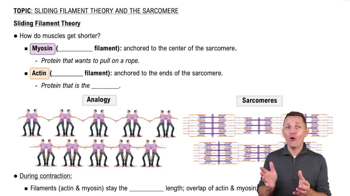
Sliding Filament Theory

Microtubules

Microtubules are hollow, tube-like structures made of tubulin protein subunits. They are part of the cytoskeleton and play key roles in maintaining cell shape, enabling intracellular transport, and facilitating cell division through the formation of the mitotic spindle. Microtubules are dynamic, constantly undergoing polymerization and depolymerization, which allows cells to adapt to various functions.
Recommended video:
03:14
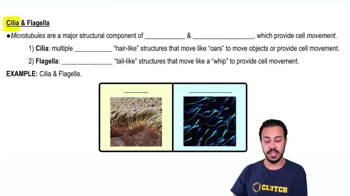
Cilia & Flagella