Ch. 25 Fluid, Electrolyte, and Acid-Base Homeostasis
Amerman- Human Anatomy & Physiology 3e
Amerman3rd EditionHuman Anatomy & PhysiologyISBN: 9780138247201, 9780138247928, 9780138201814Not the one you use?Change textbook
Chapter 25, Problem 7

Which of the following is false with respect to sodium ions in human physiology?
a. Sodium ions are the most abundant extracellular cation.
b. Sodium ions are an important osmotic particle in the ECF.
c. The entry of sodium ions into a cell causes depolarization.
d. Sodium ions are more concentrated in the cytosol than in the ECF.

Verified step by step guidance
1
Step 1: Understand the role of sodium ions (Na⁺) in human physiology. Sodium ions are crucial for maintaining osmotic balance, nerve impulse transmission, and muscle contraction. They are primarily found in the extracellular fluid (ECF).
Step 2: Analyze option (a): 'Sodium ions are the most abundant extracellular cation.' Recall that sodium ions are indeed the most abundant cation in the ECF, contributing significantly to osmotic pressure. This statement is true.
Step 3: Analyze option (b): 'Sodium ions are an important osmotic particle in the ECF.' Sodium ions play a key role in regulating water movement between compartments due to their osmotic properties. This statement is also true.
Step 4: Analyze option (c): 'The entry of sodium ions into a cell causes depolarization.' During an action potential, sodium ions enter the cell, reducing the membrane potential and causing depolarization. This statement is true.
Step 5: Analyze option (d): 'Sodium ions are more concentrated in the cytosol than in the ECF.' Sodium ions are actually more concentrated in the ECF than in the cytosol due to the action of the sodium-potassium pump. This statement is false, making it the correct answer to the question.

Verified video answer for a similar problem:

This video solution was recommended by our tutors as helpful for the problem above.
Was this helpful?

Key Concepts

Here are the essential concepts you must grasp in order to answer the question correctly.

Sodium Ion Concentration

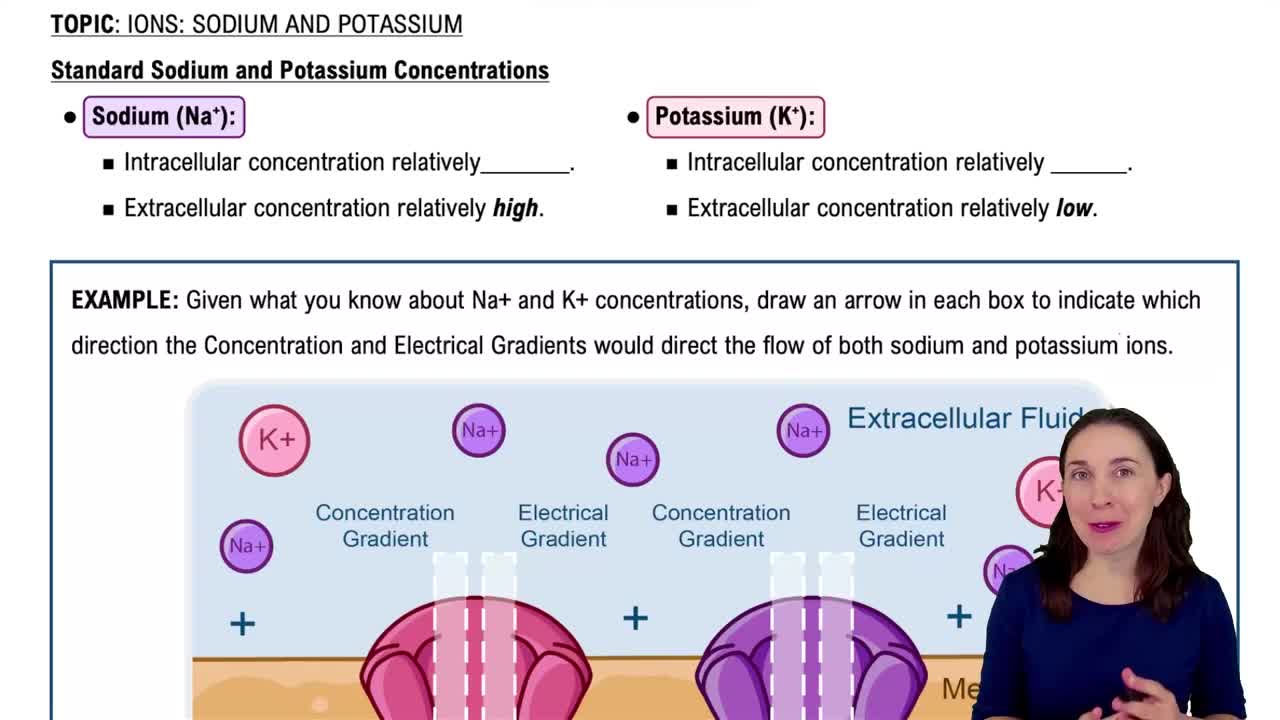
Sodium ions (Na+) are primarily found in the extracellular fluid (ECF) of the body, where they are the most abundant cation. This high concentration in the ECF is crucial for maintaining osmotic balance and proper cellular function. In contrast, sodium levels are significantly lower in the cytosol, which is essential for the generation of action potentials in neurons and muscle cells.
Recommended video:
03:35
Standard Sodium and Potassium Concentrations

Osmotic Pressure

Osmotic pressure is the force exerted by solutes, such as sodium ions, that influences the movement of water across cell membranes. Sodium ions play a vital role as osmotic particles in the ECF, helping to regulate fluid balance and blood pressure. Their concentration gradient across the cell membrane is critical for various physiological processes, including nutrient absorption and waste removal.
Recommended video:
Guided course
6:12
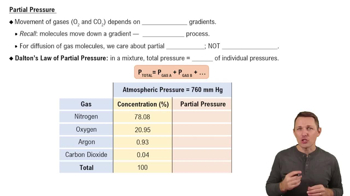
Partial Pressure

Depolarization

Depolarization refers to the change in membrane potential that occurs when sodium ions enter a cell, making the inside of the cell more positive. This process is essential for the initiation and propagation of action potentials in neurons and muscle cells. Understanding depolarization is key to grasping how signals are transmitted in the nervous system and how muscles contract.
Recommended video:
Guided course
3:49
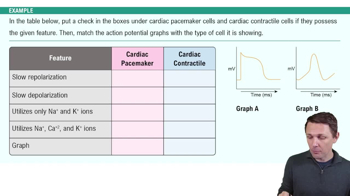
Cardiac Action Potentials Example 1
Related Practice
Textbook Question

Mark the following statements as true or false. If a statement is false, correct it to make a true statement.

a. Potassium ions are responsible for the repolarization phase of the action potential.

2
views

Textbook Question

Mark the following statements as true or false. If a statement is false, correct it to make a true statement.

d. Atrial natriuretic peptide promotes water retention in the kidneys and increases the amount of water in the body.

3
views
Textbook Question

Which of the following effects tend to be caused by hypernatremia?

a. Inhibition of ADH secretion

b. Cellular crenation

c. Cellular swelling

d. Increased urine production

1
views
Textbook Question

Mark the following statements as true or false. If a statement is false, correct it to make a true statement.

c. The main hormone that regulates fluid balance is antidiuretic hormone (ADH).

1
views
Textbook Question

Mark the following statements as true or false. If a statement is false, correct it to make a true statement.

e. Dehydration is characterized by a decreased volume and increased osmolarity of the ECF.

1
views
Textbook Question

Which of the following statements best describes the principle of mass balance?

a. The amount of a variable that is gained by the body through ingestion equals the amount that is lost from the body.

b. The body maintains a stable mass at all times.

c. The amount of each variable brought into the body must be balanced by all other variables.

d. The amount of a variable ingested is regulated by a positive feedback loop.

1
views