Ch. 25 Fluid, Electrolyte, and Acid-Base Homeostasis
Amerman- Human Anatomy & Physiology 3e
Amerman3rd EditionHuman Anatomy & PhysiologyISBN: 9780138247201, 9780138247928, 9780138201814Not the one you use?Change textbook
Chapter 25, Problem 6d

Mark the following statements as true or false. If a statement is false, correct it to make a true statement.
d. Atrial natriuretic peptide promotes water retention in the kidneys and increases the amount of water in the body.

Verified step by step guidance
1
Step 1: Begin by understanding the role of atrial natriuretic peptide (ANP). ANP is a hormone secreted by the atria of the heart in response to increased blood volume and pressure. Its primary function is to reduce blood volume and pressure by promoting the excretion of sodium and water by the kidneys.
Step 2: Analyze the statement provided. The statement claims that ANP promotes water retention in the kidneys and increases the amount of water in the body. Compare this claim with the known function of ANP.
Step 3: Identify whether the statement is true or false. Since ANP promotes the excretion of sodium and water, it does not cause water retention. Therefore, the statement is false.
Step 4: Correct the false statement to make it true. A corrected version of the statement would be: 'Atrial natriuretic peptide promotes the excretion of sodium and water by the kidneys, reducing the amount of water in the body.'
Step 5: Summarize the corrected understanding. ANP helps regulate blood pressure and volume by reducing water and sodium levels in the body, which is the opposite of what the original statement suggests.

Verified video answer for a similar problem:

This video solution was recommended by our tutors as helpful for the problem above.
Was this helpful?

Key Concepts

Here are the essential concepts you must grasp in order to answer the question correctly.

Atrial Natriuretic Peptide (ANP)

Atrial Natriuretic Peptide (ANP) is a hormone produced by the heart's atria that plays a crucial role in regulating blood pressure and fluid balance. It is released in response to increased blood volume and pressure, promoting natriuresis, which is the excretion of sodium through urine. This process leads to increased urine output and decreased blood volume, counteracting water retention.
Recommended video:
2:45
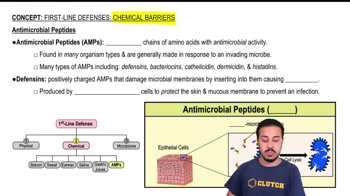
Antimicrobial Peptides

Water Retention

Water retention refers to the body's ability to hold onto excess fluid, which can lead to swelling and increased blood pressure. Hormones like aldosterone and antidiuretic hormone (ADH) typically promote water retention, while ANP has the opposite effect. Understanding the balance between these hormones is essential for comprehending fluid regulation in the body.
Recommended video:
01:54
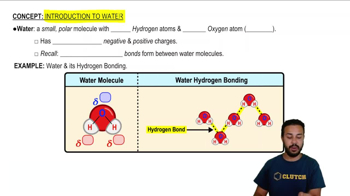
Introduction to Water

Kidney Function in Fluid Regulation

The kidneys play a vital role in maintaining fluid balance and electrolyte levels in the body. They filter blood, reabsorb necessary substances, and excrete waste products and excess fluids. Hormones such as ANP influence kidney function by altering the reabsorption of sodium and water, thereby affecting overall fluid volume and blood pressure.
Recommended video:
02:59
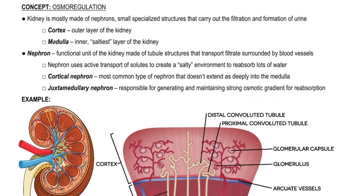
Kidney and Nephron
Related Practice
Textbook Question

Mark the following statements as true or false. If a statement is false, correct it to make a true statement.

b. The sensible water loss includes the water lost from the body via the skin and the respiratory system.

1
views

Textbook Question

Mark the following statements as true or false. If a statement is false, correct it to make a true statement.

c. The main hormone that regulates fluid balance is antidiuretic hormone (ADH).

1
views
Textbook Question

Mark the following statements as true or false. If a statement is false, correct it to make a true statement.

a. The thirst mechanism is mediated by osmoreceptors located in the cerebral cortex.

6
views
Textbook Question

Mark the following statements as true or false. If a statement is false, correct it to make a true statement.

e. Dehydration is characterized by a decreased volume and increased osmolarity of the ECF.

1
views
Textbook Question

Which of the following statements best describes the principle of mass balance?

a. The amount of a variable that is gained by the body through ingestion equals the amount that is lost from the body.

b. The body maintains a stable mass at all times.

c. The amount of each variable brought into the body must be balanced by all other variables.

d. The amount of a variable ingested is regulated by a positive feedback loop.

1
views
Textbook Question

Which of the following is false with respect to sodium ions in human physiology?

a. Sodium ions are the most abundant extracellular cation.

b. Sodium ions are an important osmotic particle in the ECF.

c. The entry of sodium ions into a cell causes depolarization.

d. Sodium ions are more concentrated in the cytosol than in the ECF.

2
views