

Ch. 24 The Urinary System
Amerman- Human Anatomy & Physiology 3e
Amerman3rd EditionHuman Anatomy & PhysiologyISBN: 9780138247201, 9780138247928, 9780138201814Not the one you use?Change textbook
Chapter 24, Problem L2.1a

Predict the effects the following scenarios would have on glomerular filtration:
a. Having excess proteins in the blood, increasing colloid osmotic pressure

Verified step by step guidance
1
Understand the concept of glomerular filtration: Glomerular filtration is the process by which the kidneys filter blood, removing waste and excess substances while retaining necessary components. It is driven by the balance of hydrostatic pressure and colloid osmotic pressure across the glomerular capillaries.
Define colloid osmotic pressure: Colloid osmotic pressure (also called oncotic pressure) is the pressure exerted by proteins, such as albumin, in the blood plasma. This pressure opposes the movement of fluid out of the capillaries and into the filtrate in the Bowman's capsule.
Analyze the effect of excess proteins in the blood: Excess proteins in the blood increase the colloid osmotic pressure. This means there is a stronger force pulling water back into the capillaries from the filtrate, opposing the hydrostatic pressure that drives filtration.
Relate the increased colloid osmotic pressure to glomerular filtration rate (GFR): When colloid osmotic pressure increases, it reduces the net filtration pressure (NFP), which is the difference between hydrostatic pressure and colloid osmotic pressure. A lower NFP results in a decreased glomerular filtration rate (GFR).
Conclude the physiological impact: The increase in colloid osmotic pressure due to excess proteins in the blood would lead to a reduction in the amount of filtrate formed in the kidneys, potentially impairing the kidney's ability to remove waste and regulate fluid balance.

Verified video answer for a similar problem:

This video solution was recommended by our tutors as helpful for the problem above.
Was this helpful?

Key Concepts

Here are the essential concepts you must grasp in order to answer the question correctly.

Glomerular Filtration Rate (GFR)

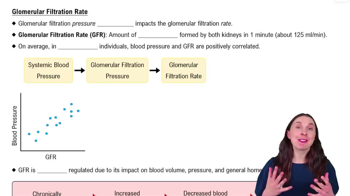
Glomerular Filtration Rate (GFR) is a measure of how well the kidneys filter blood, specifically the volume of fluid filtered from the renal glomeruli into the Bowman's capsule per unit time. It is a crucial indicator of kidney function and is influenced by factors such as blood pressure, blood flow, and the composition of blood, including protein levels.
Recommended video:
3:15
Glomerular Filtration Rate

Colloid Osmotic Pressure

Colloid osmotic pressure is the pressure exerted by proteins in the blood plasma that helps to retain water within the circulatory system. When there is an increase in colloid osmotic pressure, such as from excess proteins in the blood, it can counteract the hydrostatic pressure in the glomeruli, thereby reducing the net filtration pressure and potentially decreasing the GFR.
Recommended video:
Guided course
6:12
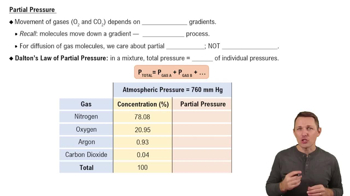
Partial Pressure

Starling Forces

Starling forces refer to the physical forces that govern the movement of fluid across capillary membranes, including hydrostatic pressure and osmotic pressure. In the context of glomerular filtration, these forces determine the net filtration pressure, which is essential for understanding how changes in blood composition, like increased protein levels, can affect the filtration process in the kidneys.
Recommended video:
Guided course
5:45
Forces That Shape the Lungs