

Mr. Gupta has been diagnosed with nephrotic syndrome, which is characterized by the loss of plasma proteins such as albumin into the urine. What impact will this have on his colloid osmotic pressure? How will this affect the net filtration pressure in his capillary beds? What effect will this likely cause?
Ch. 24 The Urinary System
Amerman3rd EditionHuman Anatomy & PhysiologyISBN: 9780138247201, 9780138247928, 9780138201814Not the one you use?Change textbook
Chapter 24, Problem L2.3
Explain why urinary tract infections, which involve the urethra and urinary bladder, are much more common in females than males.
Verified step by step guidance1
Understand the anatomical differences between the male and female urinary systems. The urethra in females is significantly shorter (approximately 3-4 cm) compared to males (approximately 20 cm). This shorter length provides a shorter pathway for bacteria to travel to the bladder.
Recognize the proximity of the female urethral opening to the anus and vaginal opening. This close anatomical relationship increases the likelihood of bacterial contamination, particularly from Escherichia coli (E. coli), which is commonly found in the gastrointestinal tract.
Consider the role of hygiene and external factors. In females, improper wiping techniques (e.g., wiping from back to front) can introduce bacteria from the anal region to the urethral opening, increasing the risk of infection.
Acknowledge the absence of a prostate gland in females. In males, the prostate gland produces antimicrobial secretions that can help reduce the risk of bacterial infections in the urinary tract. Females lack this protective mechanism.
Understand that hormonal changes in females, such as those occurring during pregnancy or menopause, can alter the vaginal and urethral environment, potentially making it more conducive to bacterial growth and increasing susceptibility to urinary tract infections.

Verified video answer for a similar problem:
This video solution was recommended by our tutors as helpful for the problem above.
Was this helpful?
Key Concepts
Here are the essential concepts you must grasp in order to answer the question correctly.
Anatomical Differences
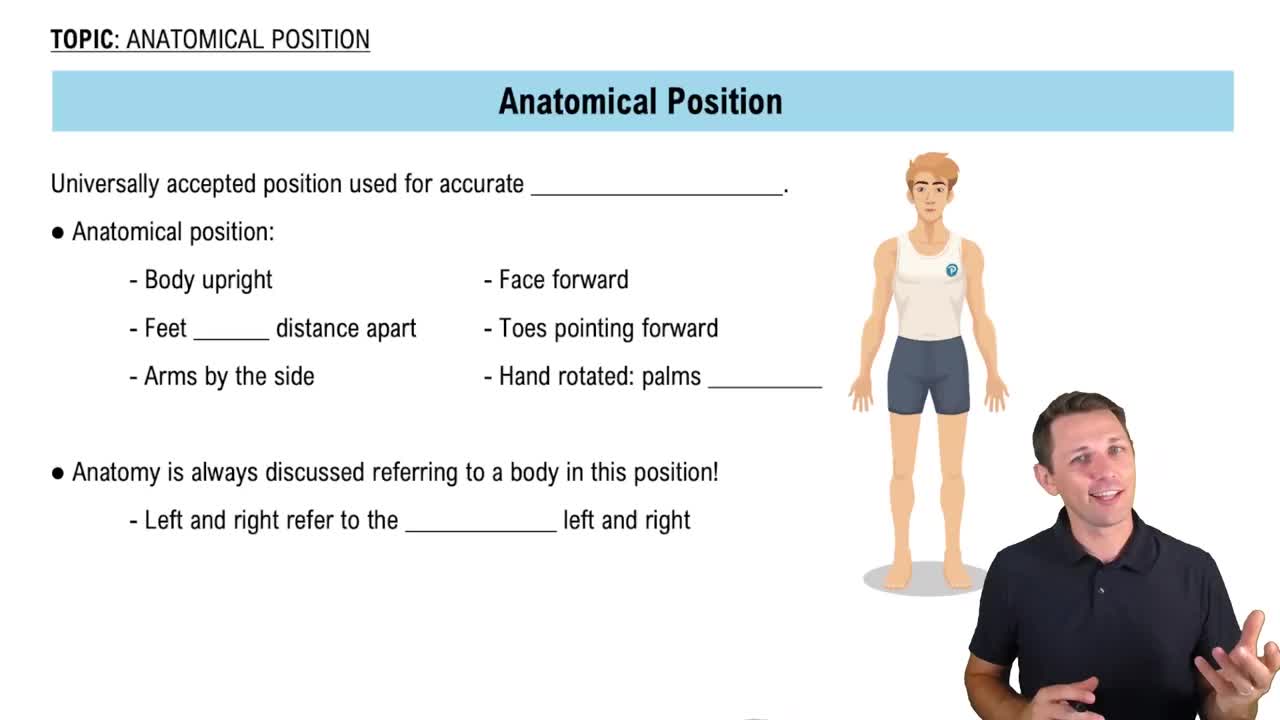
The anatomical structure of the female urinary system contributes significantly to the higher incidence of urinary tract infections (UTIs). In females, the urethra is shorter and located closer to the anus, which facilitates the easier entry of bacteria into the urinary tract compared to males, whose longer urethra provides a greater distance for bacteria to travel.
Recommended video:
Guided course
Anatomical Position
Hormonal Influences
Hormonal differences, particularly the influence of estrogen, play a role in the susceptibility to UTIs. Estrogen helps maintain the health of the vaginal flora and the integrity of the urinary tract lining. Fluctuations in hormone levels, such as during menstruation or menopause, can alter this balance, increasing the risk of infections in females.
Recommended video:
Guided course
Review of Major Hormones
Behavioral Factors
Certain behavioral factors also contribute to the higher prevalence of UTIs in females. Women are more likely to engage in activities that can introduce bacteria into the urinary tract, such as sexual intercourse. Additionally, hygiene practices and the use of certain products can affect the risk of developing UTIs, making awareness and preventive measures crucial.
Recommended video:
Environmental Factors Affecting Enzyme Activity
Related Practice
Textbook Question
2
views
Textbook Question
Why must the kidneys establish a concentration gradient in the interstitial fluid of the renal medulla in order to produce concentrated urine?
2
views
Textbook Question
Predict the effects the following scenarios would have on glomerular filtration:
c. Having high arterial blood pressure (hypertension)
1
views
Textbook Question
What might it mean if you found a high concentration of urobilinogen in your patient's urine? (Hint: Consider the source of urobilinogen.)
5
views
Textbook Question
Trace the pathway taken by a molecule of urea through the kidney from the glomerulus to the renal pelvis if the urea is recycled.
2
views
Textbook Question
Predict the effects the following scenarios would have on glomerular filtration:
a. Having excess proteins in the blood, increasing colloid osmotic pressure
1
views
